The Boy and the Glass Frog
Ebru Mina TOMURCUK
- Category Children's Fairy Tales
- Format PDF
- Size 11.1 MB
- Views 1
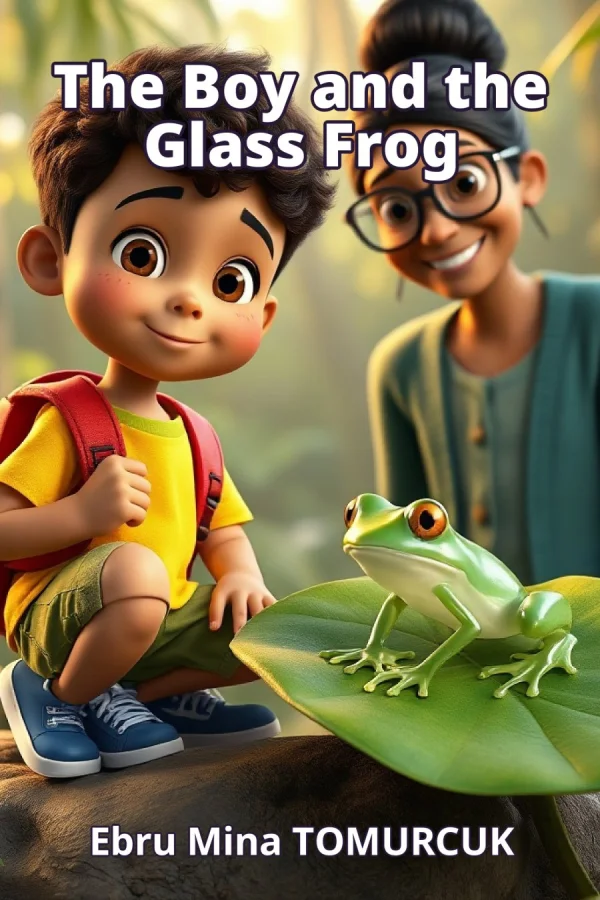
Leo has never set foot in a rainforest, but his room is a museum of its wonders: drawings of toucans, sloths, and tiny frogs cover every wall. When his teacher, Ms. Rivera, assigns a science fair project about animal habitats, Leo knows exactly what he wants to build. A single photograph in his research book captivates him: a glass frog so transparent that its heart is visible through its skin. Leo is determined to capture that see-through magic in his model.
The task proves harder than he expects. Clear plastic, tape, and clay all fail to create the illusion he imagines. Frustrated, Leo remembers the glass frog's own strategy—patience and stillness—and learns to persist. With a hint from Ms. Rivera and support from his mother, Leo transforms a shoebox, pipe cleaners, and a plastic cup into a vivid rainforest scene. The result is a model that not only looks realistic but also tells a story about adaptation and survival.
This gentle story follows a curious, creative boy as he discovers that science is as much about asking questions and solving problems as it is about facts. Young readers will learn how a glass frog's transparent skin helps it hide from predators, and they will see how determination and a little help from others can turn a difficult idea into something remarkable. Ideal for children in early elementary grades, The Boy and the Glass Frog celebrates curiosity, patience, and the joy of bringing nature into the classroom.
Read the Book
If the PDF does not appear, open it in a new tab.
A Chapter from the Book
The Boy and the Glass Frog - Author : Ebru Mina TOMURCUK
Leo loved the rainforest. He had never seen one in person, but he had read about it in books and watched videos of its amazing animals. His room was filled with pictures of brightly colored birds, slow sloths, and tiny frogs. Every day after school, he would draw the creatures he learned about. His favorite thing was learning how animals survived in the wild. He dreamed of one day visiting the real rainforest. 1
One sunny afternoon, Leo's teacher, Ms. Rivera, gave the class a special assignment. 'For our science fair, you will each build a model of a habitat,' she said, adjusting her glasses. 'Your model must show how animals are adapted to their home.' Leo's eyes grew wide with excitement. He knew exactly what to do. He would build the most amazing rainforest model ever! 2
That evening, Leo sat at the kitchen table with his notebook and pencil. He read about many rainforest animals: toucans with big beaks, monkeys with long tails, and sloths that hang upside down. Then he turned a page and gasped. There was a picture of a tiny frog. Its skin was so clear that he could see its tiny heart beating inside! It was called a glass frog, and it lived in the rainforest. 3
Leo read more about the glass frog. The little frog was only as long as a thumbnail. Its see-through skin was pale green, and its big golden eyes looked like shiny marbles. Leo learned that the glass frog's clear body helped it hide from danger. When it sat on a green leaf, it almost disappeared! Leo thought this was the cleverest adaptation he had ever heard of. 4
'I want my model to show a glass frog,' Leo said to his mom. 'But how will I make it see-through?' His mom smiled and said, 'Maybe you can use clear plastic or a special kind of clay.' Leo nodded. He was patient and loved a good challenge. He gathered his supplies: a shoebox, green paper, pipe cleaners, and a small plastic toy frog. But the toy frog was not seethrough. 5
Leo thought hard. He wanted his model to be perfect. He tried drawing the frog on clear plastic, but it did not look right. He tried making a frog from clear tape, but it was too sticky. He sighed and put his head on the table. 'This is hard,' he said. Then he remembered how the glass frog stayed still and watchful. 'Maybe I need to be patient, too,' he thought. 6
The next day at school, Leo asked Ms. Rivera for help. She adjusted her glasses and looked at his sketches. 'You have a wonderful idea,' she said. 'What if you use a clear plastic cup for the frog's body and paint tiny green spots on it?' Leo's eyes lit up. 'That's perfect!' he said. He couldn't wait to go home and try it. His red backpack bounced as he ran to the bus. 7
At home, Leo got to work. He covered the inside of the shoebox with green paper to look like leaves. He twisted brown pipe cleaners into vines and hung them across the box. He cut leaf shapes from green paper and glued them everywhere. Then he made the glass frog from a clear plastic cup, shaping it into a little frog with long legs and big golden eyes. It looked just like the picture! 8
Leo placed the glass frog on a big green leaf in the middle of the model. The frog's see-through body blended right in. 'Look, Mom!' he called. 'The frog is hiding!' His mom came over and smiled. 'It really looks like it's disappearing,' she said. Leo explained, 'That's the adaptation. The clear skin helps the frog hide from danger. Predators can't see it!' He felt proud of his work. 9
Leo added more details to his rainforest model. He made a tiny toucan with a big beak and a sloth hanging from a vine. He added a little pool of blue paper for water. But the glass frog was the star. Leo wrote a small sign that said, 'Glass Frog: My see-through skin helps me hide!' He practiced explaining his model to his family. He wanted to be ready for the science fair. 10
On the day of the science fair, Leo carried his model carefully into the classroom. He set it on his desk and waited for the other kids to arrive. Ms. Rivera walked around the room with her clipboard, looking at each project. When she reached Leo's desk, she stopped and leaned in close. 'This is wonderful,' she said. 'Tell me about your glass frog.' Leo took a deep breath and began to explain. 11
Leo spoke clearly and with excitement. 'This is a glass frog,' he said. 'It lives in the rainforest. Its skin is see-through, so it can hide on leaves. That's called an adaptation. It helps the frog stay safe from predators.' Ms. Rivera nodded and smiled. 'You've explained it perfectly,' she said. 'Would you like to share your findings with the whole class?' Leo felt nervous but also proud. He nodded. 12
Leo stood in front of the class and showed his model. He pointed to the clear frog on the leaf. 'The glass frog's clear skin is a clever trick,' he said. 'It makes the frog almost invisible. That's how it survives in the rainforest.' His classmates clapped. Ms. Rivera said, 'Leo has shown us how nature's adaptations help animals survive in wonderful ways.' Leo beamed with pride.
This section is a preview taken from the book (about 939 words). To continue, read the book or download the PDF.
Book Details
- Book
- The Boy and the Glass Frog
- Author
- Ebru Mina TOMURCUK
- Category
- Children's Fairy Tales
- Language
- English
- Format
- PDF · 11.1 MB
- Pages
- 18
- Words
- about 1,121
- Published
- onlinemasal.com.tr
- Access
- Free to read and download; for personal use only, all rights belong to the author.
Frequently Asked Questions
Is the PDF of The Boy and the Glass Frog free?
Yes. The Boy and the Glass Frog can be read and downloaded for free on this site; no sign-up or payment is required.
How many pages is The Boy and the Glass Frog?
The Boy and the Glass Frog has 18 pages and about 1,121 words.
Which devices can I read The Boy and the Glass Frog on?
It is a PDF; you can read it in your browser on a phone, tablet or computer, or download it and open it offline.
Who is the author of The Boy and the Glass Frog?
The Boy and the Glass Frog was written by Ebru Mina TOMURCUK; it is listed in the Children's Fairy Tales category.