The Turtle's Moonlight Garden
Ebru Mina TOMURCUK
- Category Children's Fairy Tales
- Format PDF
- Size 12.4 MB
- Views 2
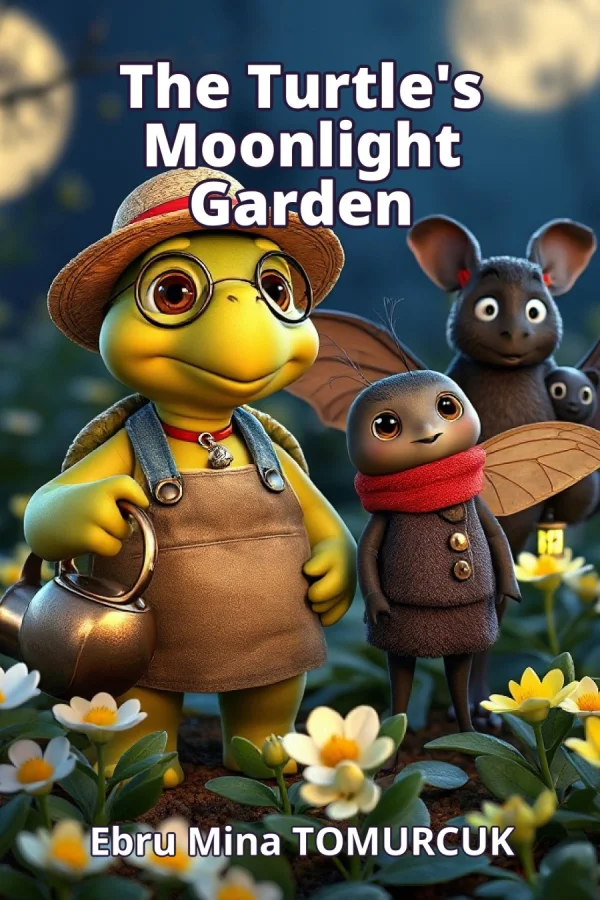
In a soft, green corner of the meadow lives a small turtle named Tilly, who wears a faded blue apron and a straw hat with a red ribbon. Every evening, once the sun slips away, she tends a garden unlike any other: moonflowers, evening primroses and night-blooming jasmine that open only after sunset. With her copper watering can and tiny spectacles, Tilly welcomes the friends who help her garden grow — Millie the moth, who carries pollen in a leaf satchel, Pip the firefly, whose glowing tail lights the paths, and Bella the bat, who scoops water from the pond and brings seeds from the meadow. Together they show that some flowers need the moon rather than the sun, and that some helpers do their best work in the dark.
The daytime animals are not convinced. A rabbit, a robin and a squirrel peer at the closed blooms one morning and insist that a proper garden should be open in the daytime, where everyone can enjoy it. Tilly explains gently that each flower has its own rhythm, but the visitors remain doubtful. So she invites day and night animals to a picnic and asks them simply to wait and watch as the sky grows dark.
This gentle picture-book tale is about curiosity, patience and respect for differences. Young readers learn that not everything beautiful happens in sunlight, and that different creatures — and different rhythms — can each contribute something special. It suits children being read to at bedtime, and early readers ready for a calm story about friendship and understanding.
Read the Book
If the PDF does not appear, open it in a new tab.
A Chapter from the Book
The Turtle's Moonlight Garden - Author : Ebru Mina TOMURCUK
In a cozy corner of the meadow, where the grass grew soft and green, lived a small turtle named Tilly. She wore a faded blue apron and a straw hat with a red ribbon. Every evening, when the sun slipped away, Tilly tended her garden. But this was no ordinary garden—it was a moonlight garden, full of flowers that opened only after sunset. 1
Tilly's shell was moss-green with amber swirls, and tiny spectacles perched on her nose. She carried a copper watering can that glinted in the twilight. Her garden was filled with moonflowers, evening primroses, and night-blooming jasmine. As the first stars appeared, the petals began to unfurl, releasing a sweet, silvery scent into the cool air. 2
Tilly smiled her slow, kind smile. 'Welcome, little ones,' she whispered. From the shadows came her friends: a moth with cream and rose wings, a firefly with a glowing tail, and a bat with large, rounded ears. They visited every night to help her garden grow. 'Each of you brings something special,' Tilly said. 'Together, we make the night beautiful.' 3
The moth, whose name was Millie, carried pollen in her tiny leaf satchel. Her feathery antennae twitched as she fluttered from flower to flower. 'These moonflowers are my favorite,' she said softly, her silver bell tinkling. 'They open just for us.' She gently dusted each bloom with golden pollen, helping the garden grow strong and bright. 4
The firefly, Pip, zoomed between the flowers, his yellow-green tail glowing like a tiny lantern. 'Follow me!' he chirped, his red scarf flapping. He lit the paths so no one would get lost. His little lantern backpack cast a warm glow on the petals. 'I'll keep the garden twinkling all night long,' he promised, doing a happy loop in the air. 5
The bat, Bella, was quiet and steady. She wore a leaf vest with two tiny buttons and a woven grass bracelet on one wing. 'I'll carry water from the pond,' she said, her voice soft. With her wide, purple-sheened wings, she scooped up droplets and sprinkled them gently over the thirsty roots. 'And I'll bring seeds from the meadow,' she added. 6
Night after night, the friends worked together. Millie pollinated, Pip lit the way, and Bella watered and planted. Tilly watched with pride. 'You see,' she said, 'some flowers need the moon, not the sun. And some helpers do their best work in the dark.' The garden flourished, glowing softly under the stars. 7
But one morning, as the sun rose, the daytime animals came to visit. A rabbit, a robin, and a squirrel peered at the closed flowers. 'Why are they all shut?' asked the rabbit, twitching his nose. 'A garden should be open in the daytime,' said the robin. 'Then everyone can enjoy it,' added the squirrel, nodding wisely. 8
Tilly stepped forward, her straw hat tilted. 'These flowers bloom at night,' she explained gently. 'They are called moonflowers and evening primroses. They open when the sun goes down.' The daytime animals looked confused. 'But that's silly,' said the rabbit. 'Flowers need sunshine to grow.' The robin chirped in agreement. 9
The daytime animals didn't understand. 'You should make them open in the day,' said the squirrel. 'Then we could all play in the garden.' Tilly shook her head slowly. 'Each flower has its own rhythm,' she said. 'Some bloom in the sun, and some bloom in the moon. Both are beautiful.' But the daytime animals still frowned. 10
That evening, Tilly called all the animals together—day and night. 'Let's have a picnic in the garden,' she suggested. 'You can see for yourselves.' The rabbit, robin, and squirrel settled on the grass as the sun set. The nocturnal animals took their places. 'Wait and watch,' said Tilly, her eyes twinkling. 11
As the sky turned dark, something magical happened. The moonflowers slowly opened their white petals, and the evening primroses unfurled in soft yellow. The garden glowed with silvery light. Millie fluttered, Pip twinkled, and Bella sprinkled water. The daytime animals gasped. 'It's beautiful!' whispered the rabbit. 'I've never seen anything like it,' said the robin. 12
Tilly smiled. 'You see,' she said, 'different rhythms deserve respect. The night animals help the night flowers, and the day animals help the day flowers. We all have our own time.' The squirrel nodded. 'I'm sorry we doubted you,' he said. 'Your garden is wonderful, even if it blooms at night.' The others agreed, their eyes wide with wonder. 13
From that night on, the daytime animals often visited the moonlight garden. They learned to appreciate the quiet beauty of the night. Sometimes they brought seeds from the sunny meadow, and Bella planted them for the day. The garden became a place where day and night met, and everyone was welcome. 14
Tilly tended her garden with love, and her friends—Millie, Pip, and Bella—never missed a night. The daytime animals brought treats to share. Together, they celebrated their differences under the moon and stars. 'Different rhythms,' Tilly said, 'make the world a richer place.' And the garden bloomed on, a peaceful haven for all. 15
So if you ever pass by a garden that glows in the moonlight, listen closely. You might hear the tinkle of a silver bell, the hum of a tiny lantern, and the soft flap of purple wings. And you'll know that a wise turtle and her friends are caring for the flowers, teaching us all to respect each other's rhythms.
This section is a preview taken from the book (about 922 words). To continue, read the book or download the PDF.
Book Details
- Book
- The Turtle's Moonlight Garden
- Author
- Ebru Mina TOMURCUK
- Category
- Children's Fairy Tales
- Language
- English
- Format
- PDF · 12.4 MB
- Pages
- 18
- Words
- about 923
- Published
- onlinemasal.com.tr
- Access
- Free to read and download; for personal use only, all rights belong to the author.
Frequently Asked Questions
Is the PDF of The Turtle's Moonlight Garden free?
Yes. The Turtle's Moonlight Garden can be read and downloaded for free on this site; no sign-up or payment is required.
How many pages is The Turtle's Moonlight Garden?
The Turtle's Moonlight Garden has 18 pages and about 923 words.
Which devices can I read The Turtle's Moonlight Garden on?
It is a PDF; you can read it in your browser on a phone, tablet or computer, or download it and open it offline.
Who is the author of The Turtle's Moonlight Garden?
The Turtle's Moonlight Garden was written by Ebru Mina TOMURCUK; it is listed in the Children's Fairy Tales category.