The Girl and the Sand Cat
Ebru Mina TOMURCUK
- Category Children's Fairy Tales
- Format PDF
- Size 11.5 MB
- Views 3
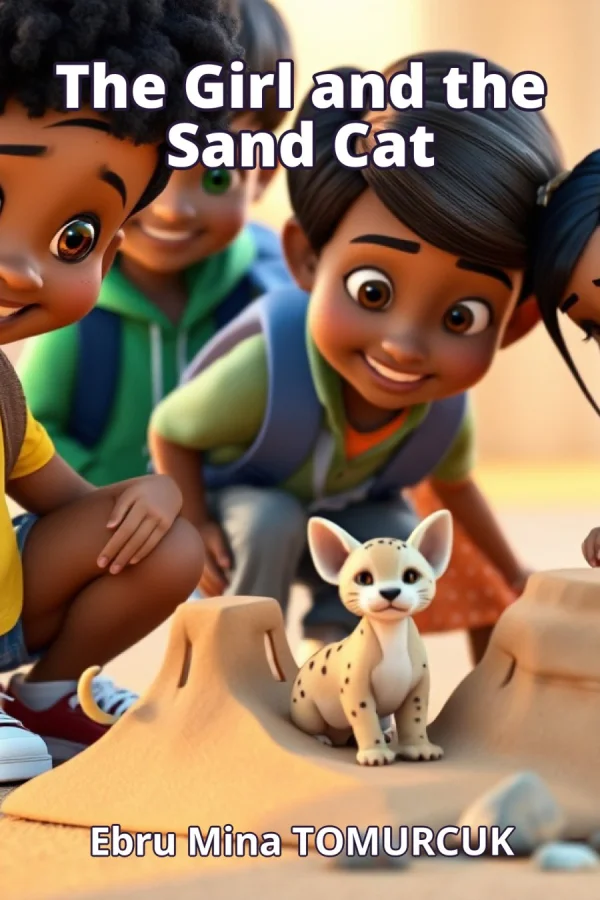
Maya loves wildcats more than anything. Her yellow shirt carries a big paw print, and her explorer satchel holds a notebook full of cat facts. She has read about lions, tigers and cheetahs, but one day she discovers a wildcat she has never heard of: the sand cat. Small enough to fit along her arm, with pale sandy fur, a broad flat head and huge wide-set ears, it seems impossible that such a little cat could survive in a hot, dry desert. Maya wants to understand how it manages, and her question sets the whole story in motion.
At school she shares the picture with her friend Leo, and together they decide to build a desert habitat model to see how the sand cat's world works. After school they gather a cardboard box, sand, smooth stones and a cardboard tube, and in Maya's room they shape dunes, arrange rocks and dig a cool burrow. As they test each feature with a tiny toy cat, the children work out the adaptations one by one: thick fur on the paws that protects against burning sand and keeps the cat from sinking, oversized ears that catch the faint sounds of prey moving underground, and a burrow where the animal rests through the heat of the day. Their friend Priya joins them, adding rocks and helping make labels, and the three children turn their model into something others can learn from.
The next day they present the habitat to their class, explaining each adaptation and answering their classmates' questions. The book follows a curious child who turns a question into a hands-on project, and it shows young readers how observation, research and teamwork can explain how a real animal survives in a difficult environment. It suits children in the early primary years who are beginning to explore animals, habitats and the idea of adaptation, and who enjoy seeing their own curiosity lead somewhere concrete.
Read the Book
If the PDF does not appear, open it in a new tab.
A Chapter from the Book
The Girl and the Sand Cat - Author : Ebru Mina TOMURCUK
Maya loved wildcats more than anything. Her yellow shirt had a big paw print, and her explorer satchel held a notebook full of cat facts. She read about lions, tigers, and cheetahs. But one day, she found a new wildcat in her book: the sand cat. "I've never heard of that one!" she said, her dark brown eyes wide. 1
The sand cat was small, about as long as Maya's arm. It had pale sandy fur, a broad flat head, and huge wide-set ears. Its amber eyes had thick black rims. "How does such a little cat live in a hot, dry desert?" Maya wondered. She looked at the picture and imagined its furry paws walking on burning sand. 2
Maya showed the picture to her friend Leo at school. Leo wore his green hoodie and carried a blue backpack. "A cat in the desert?" he said, his gap-toothed smile showing. "That seems impossible. There's no water!" Maya grinned. "That's what I want to find out," she said. "Let's build a desert habitat model and see how it works." 3
After school, Maya and Leo gathered supplies. Maya brought a big cardboard box from home. Leo found a bag of sand from the craft corner. "We need rocks, too," Maya said, checking her notebook. "And something for a burrow." They set everything on a table in Maya's room. The box looked empty and brown. "Where do we start?" Leo asked. 4
Maya poured the sand into one side of the box. It felt warm from the sun. She shaped it into little dunes with her hands. "Deserts have sand and rocks," she said. Leo placed smooth stones around the dunes. "What about the burrow?" he asked. Maya found a small cardboard tube. "Sand cats dig burrows to stay cool," she said. "Let's make one." 5
Maya dug a tunnel in the sand and pushed the tube inside. She covered it with more sand, leaving a small opening. "That's the burrow," she said. "Now the sand cat can hide from the hot sun." Leo looked doubtful. "But how will we know if it works?" Maya picked up a tiny toy cat. "We'll test it with this model cat!" she said. 6
Maya placed the toy cat on the sand. "First, the paws," she said. "Sand cats have thick fur on their paws. It protects them from hot sand and helps them walk without sinking." She pressed the toy cat's feet into the sand. It didn't sink. "See? Big furry paws are an adaptation!" Leo nodded slowly. 7
Next, Maya pointed to the toy cat's ears. "Sand cats have huge ears. They can hear tiny sounds, like a mouse moving under the sand." She cupped her hands behind her ears. "I can hear better this way!" Leo laughed. "So big ears help them find food," he said. "That's clever." Maya wrote "big ears" in her notebook. 8
Priya came over to help. Her long black braid swung as she looked at the model. "It looks like a real desert!" she said. She wore her orange dress with white dots and star-shaped hair clips. Maya showed her the burrow. "Sand cats stay in burrows during the day," Maya explained. "They come out at night when it's cooler." 9
Priya arranged more rocks around the burrow. "What else does the sand cat need?" she asked. Leo looked at the model. "Maybe some plants?" he said. Maya shook her head. "Deserts have very few plants. Sand cats get water from their food." Leo's eyes went wide. "They don't drink water?" Maya smiled. "They adapt!" 10
Maya placed the toy cat inside the burrow. "The burrow is cool and safe," she said. "That's another adaptation." Leo scratched his head. "But how do we show that to others?" Maya thought. "We can make a sign," she said. "And we can let them try the model." Priya clapped. "Let's make little labels for each adaptation." 11
They wrote labels: "Big furry paws," "Huge ears," "Cool burrow." Maya taped them to the box. Then she made a tiny sand cat out of clay. It had big ears and a black-tipped tail. "Now it looks real!" Priya said. Maya felt proud. "We can share this with our class," she said. "Everyone can learn about sand cats." 12
The next day, they brought the model to class. Maya stood in front of her friends. She wore her yellow paw-print shirt. "This is a sand cat's habitat," she said. "Sand cats adapt to the desert." She showed the big paws. "These help them walk on sand." She pointed to the ears. "These help them hear prey." Her classmates listened carefully. 13
Leo held up the toy cat. "This is the model sand cat," he said. "It lives in the burrow during the day." Priya showed the labels. "We can all learn from models," she said. The class asked questions. "Do sand cats have enemies?" one child asked. Maya said, "They are very good at hiding." Everyone wanted to see the model up close. 14
After the presentation, Maya's teacher smiled. "You did a wonderful job showing how animals adapt," she said. Maya's warm brown cheeks glowed. She looked at her friends. "We learned that even in a harsh place, animals find ways to survive," she said. Leo grinned his gap-toothed smile. Priya nodded, her star clips shining.
This section is a preview taken from the book (about 904 words). To continue, read the book or download the PDF.
Book Details
- Book
- The Girl and the Sand Cat
- Author
- Ebru Mina TOMURCUK
- Category
- Children's Fairy Tales
- Language
- English
- Format
- PDF · 11.5 MB
- Pages
- 18
- Words
- about 970
- Published
- onlinemasal.com.tr
- Access
- Free to read and download; for personal use only, all rights belong to the author.
Frequently Asked Questions
Is the PDF of The Girl and the Sand Cat free?
Yes. The Girl and the Sand Cat can be read and downloaded for free on this site; no sign-up or payment is required.
How many pages is The Girl and the Sand Cat?
The Girl and the Sand Cat has 18 pages and about 970 words.
Which devices can I read The Girl and the Sand Cat on?
It is a PDF; you can read it in your browser on a phone, tablet or computer, or download it and open it offline.
Who is the author of The Girl and the Sand Cat?
The Girl and the Sand Cat was written by Ebru Mina TOMURCUK; it is listed in the Children's Fairy Tales category.