The Girl and the Little Echidna
Ebru Mina TOMURCUK
- Category Children's Fairy Tales
- Format PDF
- Size 12.4 MB
- Views 1
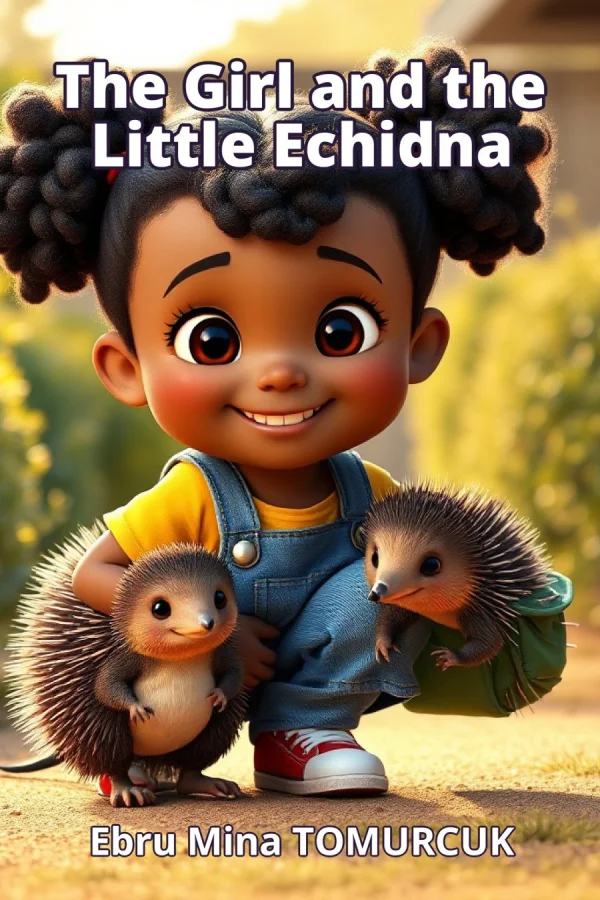
Maya is a curious girl with warm brown skin, curly black hair tied in two puffy buns, and a green canvas satchel full of pencils and a sketchbook. One sunny morning she hears a rustle in the backyard bushes and discovers a tiny creature with a spiny brown back, a soft cream belly, a long slender snout and small black eyes. Sitting still so the shy animal will trust her, she begins to draw it, then hurries to her bookshelf to identify it: an echidna, a mammal that lays eggs.
Eager to understand her new friend, Maya watches it dig for ants and records what she sees. She learns that echidnas are called spiny anteaters, that they use a sticky tongue to catch ants and termites, and that a mother carries a single leathery egg in a pouch on her belly. She turns her notes and drawings into a colorful science booklet titled "The Amazing Echidna," adding a page about the platypus, another egg-laying mammal, and practices presenting it to her class.
The story follows Maya from first sighting to classroom presentation, showing how patient observation, a sketchbook and a library book can turn a backyard surprise into real knowledge shared with others. It is suited to young readers who are beginning to explore nature and to adults reading aloud with them, and its lesson is that curiosity, careful looking and the willingness to share what you learn can inspire the people around you.
Read the Book
If the PDF does not appear, open it in a new tab.
A Chapter from the Book
The Girl and the Little Echidna - Author : Ebru Mina TOMURCUK
Maya was a curious girl with warm brown skin and curly black hair tied in two puffy buns. She loved exploring nature with her green canvas satchel full of pencils and a sketchbook. One sunny morning, she heard a rustle in the backyard bushes. "What could that be?" she wondered, her big dark eyes sparkling with excitement. 1
Maya tiptoed closer and parted the leaves. There, snuffling in the dirt, was a tiny creature with a spiny brown back and a soft cream belly. It had a long, slender snout and tiny black eyes. "Hello, little one," Maya whispered. The creature looked up, curious but shy, its little clawed feet scratching the ground gently. 2
Maya sat very still, and the little echidna waddled closer. It sniffed her red sneakers and made a soft, friendly snuffle. "You're not like other animals I know," Maya said. "What are you?" The echidna tilted its head as if listening. Maya carefully opened her sketchbook and began to draw the strange, wonderful creature. 3
Maya drew the echidna's long snout and spiny back. She noticed its tiny eyes and sturdy claws. "I wish I knew more about you," she said. The echidna snuffled and poked its nose into a pile of leaves. Maya followed, her curiosity growing. She wondered what this little animal ate and where it lived. There was so much to learn! 4
Maya decided to find out more. She ran to her bookshelf and pulled out a big book about animals. She flipped through the pages until she found a picture that looked just like her new friend. "Echidna!" she read aloud. "It says echidnas are mammals, but they lay eggs!" Her eyes grew wide. "Mammals that lay eggs? That's amazing!" 5
Maya couldn't wait to tell someone. She ran to her mom. "Mom, did you know there are mammals that lay eggs? Echidnas do!" Her mom smiled. "That's right, Maya. Echidnas and platypuses are special egg-laying mammals." Maya's mind raced with questions. She wanted to know everything about these unusual animals. She decided to make a science booklet all about them. 6
Maya returned to the backyard with her sketchbook and pencils. The little echidna was still there, digging for ants with its long snout. Maya watched and drew. She drew the echidna eating, walking, and curling into a spiny ball. She wrote down facts: "Echidnas have spines like a hedgehog. They use their long snout to sniff out food." 7
Maya learned that echidnas are called "spiny anteaters" because they eat ants and termites. She drew a picture of an echidna using its sticky tongue to catch ants. She also learned that mother echidnas lay a single leathery egg and carry it in a pouch on their belly. "A pouch! Like a kangaroo!" Maya exclaimed. She added that to her booklet. 8
Maya wanted her booklet to be fun and colorful. She drew a big title: "The Amazing Echidna." She decorated the pages with drawings of echidnas in different poses. She wrote: "Echidnas are mammals, but they lay eggs. That makes them very special!" She added a drawing of a platypus, another egglaying mammal, swimming in a river. 9
Maya thought about how to share her booklet. She could show her class at school. She imagined standing in front of her friends, opening her booklet, and saying, "Did you know some mammals lay eggs?" She practiced her presentation, pointing to her drawings. The little echidna watched from the grass, as if cheering her on. 10
Finally, Maya's booklet was complete. She had drawn twelve pages of echidna facts, with colorful pictures and fun captions. She showed it to her family. "This is wonderful, Maya!" said her dad. "You've made a real science booklet." Maya beamed. She couldn't wait to share it with her class and tell them all about the amazing echidna. 11
The next day, Maya brought her booklet to school. She stood in front of her classmates and opened it. "This is an echidna," she said. "It's a mammal that lays eggs!" Her friends gasped with surprise. Maya showed them her drawings and told them all the facts she had learned. Everyone wanted to know more about these strange and wonderful animals. 12
Maya's teacher, Mrs. Lee, smiled. "Maya has shown us something important," she said. "Nature is full of surprises. There are so many different animals, and each one is special." Maya felt proud. She had learned something new and shared it with others. The little echidna had inspired her to explore and to teach. 13
Maya's booklet became a favorite in the classroom. Her friends asked to borrow it and read it during quiet time. Some of them even started their own nature booklets. Maya realized that sharing what she learned could spark curiosity in others. She decided to keep exploring and writing about the amazing animals in the world. 14
Maya returned to the backyard to thank the little echidna. It was snuffling near the bushes, as if waiting for her. "Thank you," she whispered. "Because of you, I learned something amazing." The echidna looked up with its tiny black eyes and gave a soft snuffle. Maya knew they would always be friends. 15
Maya sat under a tree and opened her sketchbook to a new page. She drew the echidna one more time, with its spiny back and long snout. Underneath, she wrote: "Nature is full of surprises. Never stop exploring." She smiled, thinking of all the other wonderful animals waiting to be discovered. What a wonderful world of animals to explore!
This section is a preview taken from the book (about 938 words). To continue, read the book or download the PDF.
Book Details
- Book
- The Girl and the Little Echidna
- Author
- Ebru Mina TOMURCUK
- Category
- Children's Fairy Tales
- Language
- English
- Format
- PDF · 12.4 MB
- Pages
- 18
- Words
- about 939
- Published
- onlinemasal.com.tr
- Access
- Free to read and download; for personal use only, all rights belong to the author.
Frequently Asked Questions
Is the PDF of The Girl and the Little Echidna free?
Yes. The Girl and the Little Echidna can be read and downloaded for free on this site; no sign-up or payment is required.
How many pages is The Girl and the Little Echidna?
The Girl and the Little Echidna has 18 pages and about 939 words.
Which devices can I read The Girl and the Little Echidna on?
It is a PDF; you can read it in your browser on a phone, tablet or computer, or download it and open it offline.
Who is the author of The Girl and the Little Echidna?
The Girl and the Little Echidna was written by Ebru Mina TOMURCUK; it is listed in the Children's Fairy Tales category.