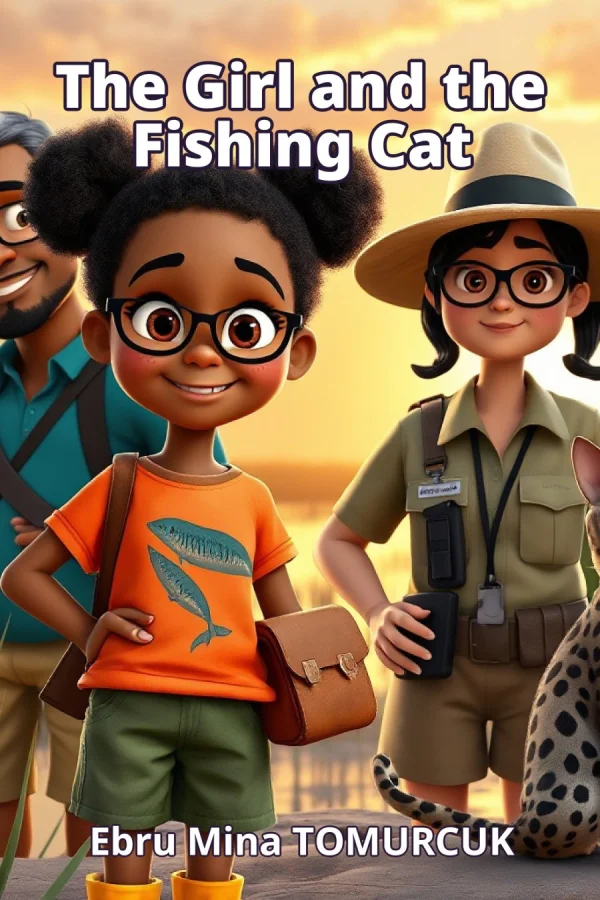
The Girl and the Fishing Cat
Ebru Mina TOMURCUK
- Category Children's Fairy Tales
- Format PDF
- Size 11.5 MB
- Views 4
Maya puts on her yellow rain boots and orange fish-print t-shirt and sets out with her dad for a day at the wetland reserve, hoping to learn about a shy wildcat called the fishing cat. At the visitor center they meet Ms. Rivera, a friendly ranger who leads them along a wooden boardwalk and explains how these cats are built for life in the marsh. Patient and quiet, Maya keeps her notebook open, sketching paws and jotting facts while dragonflies zip over the water.
The reward for their patience comes when a stocky, olive-grey cat with dark spots and amber eyes appears among the reeds. Maya watches it dive and surface with a fish in its mouth, and she learns how slightly webbed paws, a flattened tail and a taste for fish make the fishing cat an expert swimmer and hunter. But the day also brings a harder lesson: clean water, tall reeds and plenty of fish are disappearing as wetlands are polluted or filled in.
Back home, Maya turns what she has seen into a poster and a small booklet, sharing it with her class, her teacher and her family, and then joining volunteers to pick up litter along the boardwalk. The story shows young readers how curiosity, careful observation and small, practical actions can help protect an unusual animal and the habitat it depends on. It suits children who enjoy nature stories and are beginning to think about conservation.
Read the Book
If the PDF does not appear, open it in a new tab.
A Chapter from the Book
The Girl and the Fishing Cat - Author : Ebru Mina TOMURCUK
Maya stood at the edge of the wetlands, her yellow rain boots sinking slightly into the soft mud. She wore her favorite orange t-shirt with the fish print and carried a small canvas satchel for her notebook. Today, she would learn about a special wildcat called the fishing cat. "Ready to explore?" asked Dad, adjusting his sun hat and binoculars. Maya nodded eagerly, her curly puff buns bouncing. 1
Dad drove them to the wetland reserve, where tall grasses swayed in the breeze and dragonflies zipped over the water. Maya's dark brown eyes sparkled behind her round glasses. She noticed freckles of sunlight dancing on the ripples. "Fishing cats live here?" she asked. "They do," said Dad. "But they're shy and hard to spot. We'll need to be patient and quiet." Maya grabbed her notebook, ready to write. 2
A friendly ranger named Ms. Rivera greeted them at the visitor center. Her olive-green uniform had a name badge, and her ponytail swished as she pointed toward the marsh. "Welcome! I hear you want to learn about our fishing cats," she said with a crinkly smile. "They're amazing swimmers, but they need healthy wetlands to survive." Maya scribbled in her notebook. "I can't wait to see one!" she said. 3
Ms. Rivera led them along a wooden boardwalk, explaining how the fishing cat has special paws. "Their paws are slightly webbed, like little paddles, so they can swim easily," she said. Maya sketched a paw in her notebook. Dad took photos with his camera. "Look!" whispered Ms. Rivera, pointing. Through the reeds, they saw a stocky, olive-grey cat with dark spots and stripes, its amber eyes fixed on the water. 4
The fishing cat crouched low at the water's edge, its short flattened tail twitching. Maya held her breath. With a splash, the cat dived in and came up with a fish in its mouth! "Wow!" Maya whispered. "It really does fish!" The cat shook its wet fur and padded away. "Their webbed paws help them swim, and their love of fish makes them expert hunters," Ms. Rivera explained. Maya wrote it all down. 5
Back at the visitor center, Maya studied a display about wetland habitats. She learned that fishing cats need clean water, tall reeds for hiding, and plenty of fish. "When wetlands are healthy, fishing cats thrive," Ms. Rivera said. "But when people pollute or fill in wetlands, these cats lose their homes." Maya frowned. "That's sad," she said. "How can we help?" 6
Ms. Rivera smiled. "We can protect wetlands by keeping them clean and teaching others about them. Your project could help!" Maya's gap-toothed grin spread wide. She decided to make a poster and a little booklet about the fishing cat's adaptations. Dad promised to print her photos. "I'll share it with my class and my family," Maya said proudly. "They'll want to help too!" 7
That evening, Maya sat at the kitchen table with her notebook, colored pencils, and Dad's photos. She drew the fishing cat's webbed paws, its spotted coat, and its short tail. She wrote: "Fishing cats swim with webbed paws and eat fish. They need wetlands to live." Dad helped her cut out the photos and glue them onto the poster. "This is going to be great," he said. 8
The next day, Maya brought her project to school. Her friends gathered around as she explained how the fishing cat dives for fish and hides in the reeds. "Their paws are like little paddles!" she said. Her teacher, Ms. Chen, asked, "Why are wetlands important?" Maya answered, "They give fishing cats a safe home. If we take care of wetlands, we protect amazing animals." Her friends clapped. 9
At home, Maya showed her family the poster. Her little brother, Leo, pointed at the picture of the fishing cat. "Does it really swim?" he asked. "Yes!" Maya said. "And its paws help it paddle." Her grandma smiled. "I didn't know such wildcats existed," she said. Maya beamed. "Now you do! And we can all help keep wetlands clean." 10
The following weekend, Maya and Dad returned to the wetlands with Ms. Rivera. They joined a group of volunteers picking up litter along the boardwalk. Maya wore gloves and carried a big bag. "Every little bit helps," Ms. Rivera said. "Healthy wetlands protect unusual species like the fishing cat." Maya felt proud. She was making a difference. 11
As they cleaned, Maya spotted the fishing cat again, watching from the reeds. Its amber eyes seemed to say thank you. "Look!" she whispered. The cat blinked slowly, then slipped away. "I think it knows we're helping," Dad said. Maya smiled. "I'll keep protecting its home," she promised. She added a new page to her notebook: "How I helped the fishing cat." 12
Back at school, Maya's class started a Wetland Warriors club. They made posters and wrote letters to local leaders asking them to keep wetlands safe. Maya's project was displayed in the library. "You've inspired us all," said Ms. Chen. Maya's gaptoothed smile stretched from ear to ear. She knew that even small actions could make a big difference for the fishing cat. 13
That night, Maya sat on her bed and looked at her notebook. She had drawn the fishing cat with its webbed paws, its spotted coat, and its amber eyes. She wrote: "Healthy wetlands give fishing cats a safe home. We can protect them by keeping water clean and teaching others." She closed the notebook, feeling happy and proud.
This section is a preview taken from the book (about 927 words). To continue, read the book or download the PDF.
Book Details
- Book
- The Girl and the Fishing Cat
- Author
- Ebru Mina TOMURCUK
- Category
- Children's Fairy Tales
- Language
- English
- Format
- PDF · 11.5 MB
- Pages
- 18
- Words
- about 1,050
- Published
- onlinemasal.com.tr
- Access
- Free to read and download; for personal use only, all rights belong to the author.
Frequently Asked Questions
Is the PDF of The Girl and the Fishing Cat free?
Yes. The Girl and the Fishing Cat can be read and downloaded for free on this site; no sign-up or payment is required.
How many pages is The Girl and the Fishing Cat?
The Girl and the Fishing Cat has 18 pages and about 1,050 words.
Which devices can I read The Girl and the Fishing Cat on?
It is a PDF; you can read it in your browser on a phone, tablet or computer, or download it and open it offline.
Who is the author of The Girl and the Fishing Cat?
The Girl and the Fishing Cat was written by Ebru Mina TOMURCUK; it is listed in the Children's Fairy Tales category.