The Crab's Coral Calendar
Ebru Mina TOMURCUK
- Category Children's Fairy Tales
- Format PDF
- Size 10.9 MB
- Views 2
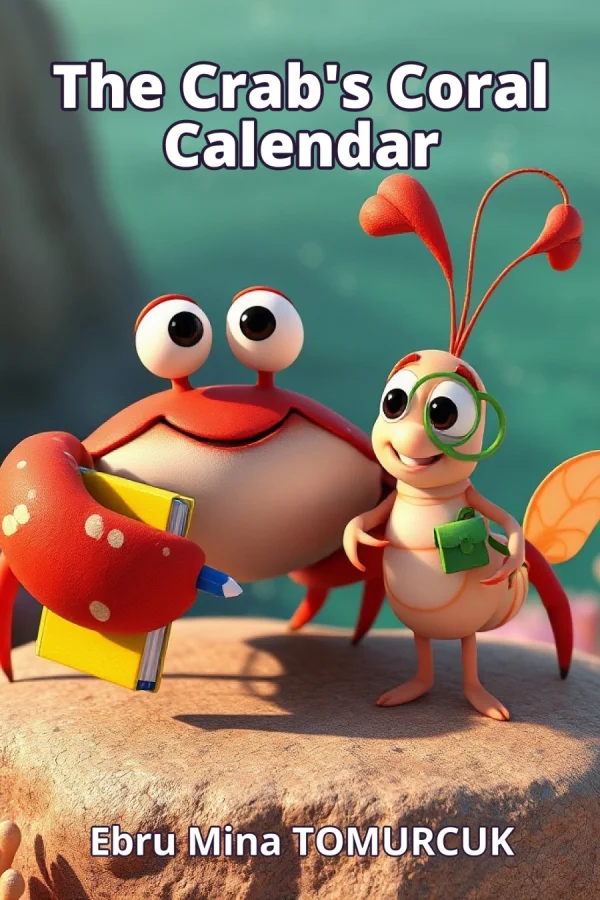
On a bright coral reef where the water sparkles like blue glass, a cheerful crab named Crabble keeps a tiny waterproof journal with a yellow cover and a short blue pencil tucked under his oversized claw. Every morning he sets out to find something new, and his favorite companion is Pip, a tiny shrimp with a leaf satchel and a magnifying glass who is always ready to ask, "What will we discover today?" Together they record new coral polyps, a small yellow fish with blue dots, and the everyday wonders of their home.
Then the reef begins to change. Sand shifts around Crabble's favorite rock, white spots appear on a patch of coral, and the tiny fish swim away. Instead of panicking, the two friends write everything down and watch. They question the old sea turtle, who notices the water feels warmer, and a school of silvery fish, who explain that the little plants the tiny fish eat are disappearing. By charting where the white spots appear, Crabble and Pip realize the damage is worst where the water is still and warm, and they trace the cause to thick seaweed blocking the current.
The story shows young readers how careful observation, patient note-taking and teamwork can turn a worrying mystery into a solvable problem. Crabble and Pip call a reef meeting, share their calendar with the turtle, the fish and a shy octopus, and everyone works together to clear a path for the water. The book suits children who enjoy gentle animal tales and offers a simple, hopeful introduction to reef life, curiosity and looking after the natural world.
Read the Book
If the PDF does not appear, open it in a new tab.
A Chapter from the Book
The Crab's Coral Calendar - Author : Ebru Mina TOMURCUK
On a bright coral reef, where the water sparkled like blue glass, lived a cheerful crab named Crabble. His shell was coral-red with cream speckles, and his big round eyes sat on short stalks, always looking about. He carried a tiny waterproof journal with a yellow cover and a short blue pencil tucked under his oversized claw. Every morning, Crabble wrote down something new he saw on the reef. 'Today,' he said, 'I will find three wonderful things!' 1
Crabble's favorite spot was a flat rock beside a busy shrimp named Pip. Pip was tiny, about half Crabble's size, with a translucent peach-pink body and soft orange stripes. Her long antennae waved as she talked, and she wore a little green leaf satchel holding a small magnifying glass. 'Good morning, Crabble!' Pip chirped. 'What will we discover today?' Crabble smiled his curved smile. 'Let's look closely and see!' 2
Together, they explored the coral reef. Crabble's six thin walking legs tapped softly on the sand as he followed Pip. 'Look!' said Pip, peering through her magnifying glass. 'A new coral polyp!' Crabble wrote in his calendar: 'New coral, small and pink, near the big rock.' Then Pip spotted a tiny fish hiding in the seaweed. Crabble added: 'Tiny fish, yellow with blue dots.' The calendar was filling up with colorful notes. 3
One morning, Crabble noticed something strange. The sand around his favorite rock had shifted, and a small piece of coral was covered in white spots. 'Oh no!' he said. 'The reef is changing, and I don't know why.' Pip zoomed over, her antennae twitching. 'Let's write it down and watch,' she said. 'Maybe we can find out what's happening.' Crabble nodded and made a new entry: 'White spots on coral. Sand moved.' 4
Each day, Crabble and Pip visited the coral. They wrote down everything: the white spots growing bigger, the tiny fish swimming away, and the sand piling up in new places. 'The calendar is like a story,' said Pip. 'A story of the reef.' Crabble agreed. 'But I wish the story had a happy ending.' He tapped his blue pencil on the yellow cover, thinking hard. 5
Pip had an idea. 'Let's ask the other reef creatures if they've noticed anything.' So they swam to the old sea turtle, who was nibbling sea grass. 'Have you seen the white spots on the coral?' asked Crabble. The turtle nodded slowly. 'Yes, and the water feels warmer than before.' Crabble wrote that down. 'Warmer water,' he muttered. 'That could be important.' 6
Next, they talked to a school of silvery fish. 'The tiny fish left because there's less food,' said one fish. 'The warm water makes the little plants disappear.' Crabble added: 'Less food for tiny fish.' Pip's bead eyes grew wide. 'We need to tell everyone!' she said. 'But first, let's keep watching,' said Crabble. 'Observation helps us understand.' 7
Crabble and Pip made a big chart in the journal. They drew the reef and marked where the white spots were. 'Look,' said Crabble, pointing with his big claw. 'The white spots are only where the water is still and warm.' Pip used her magnifying glass to check. 'You're right! The coral there is getting too warm.' They decided to find out why the water was still. 8
They followed the warm water to a place where seaweed had grown very thick. 'The seaweed blocks the water flow,' said Pip. 'So the water gets warm and still.' Crabble wrote: 'Seaweed too thick. Water not moving.' He looked at Pip. 'Can we fix this?' Pip smiled. 'We can try! We can ask our friends to help clear some seaweed.' 9
Crabble and Pip called a meeting on the flat rock. The sea turtle, the silvery fish, and even a shy octopus came. Crabble showed them his calendar. 'The reef is getting warm because the seaweed blocks the water,' he explained. 'If we clear a little seaweed, the water can flow again.' Everyone agreed to help. They worked together, pulling just enough seaweed to make a path for the water. 10
Day by day, Crabble and Pip watched the reef. They wrote in the calendar: 'Water moving again. White spots getting smaller.' The tiny fish came back to nibble the little plants. New coral polyps began to grow. 'It's working!' cheered Pip, twirling her fan tail. Crabble smiled his big curved smile. 'Our careful observation helped us solve the problem.' 11
The other creatures thanked Crabble and Pip. 'Your calendar saved our reef,' said the sea turtle. Crabble felt proud. 'It wasn't just the calendar,' he said. 'It was watching closely and working together.' Pip nodded, her antennae bobbing. 'And we'll keep watching,' she said. 'Because the reef is always changing, and we can always learn something new.' 12
From that day on, Crabble and Pip kept their coral calendar going. Each morning, they explored the reef and wrote down what they saw. Sometimes it was a new shrimp, or a different colored fish, or a piece of coral that had grown. The journal filled up with colorful drawings and notes. 'Every day is a new page,' said Crabble happily. 13
Other young reef creatures began to help. They took turns using Pip's magnifying glass and added their own observations to the calendar. Crabble taught them how to look for small changes. 'Even the tiniest thing can tell you something big,' he said. Pip handed out little leaf notebooks, just like her satchel. The reef was full of curious eyes and busy pencils.
This section is a preview taken from the book (about 931 words). To continue, read the book or download the PDF.
Book Details
- Book
- The Crab's Coral Calendar
- Author
- Ebru Mina TOMURCUK
- Category
- Children's Fairy Tales
- Language
- English
- Format
- PDF · 10.9 MB
- Pages
- 18
- Words
- about 1,054
- Published
- onlinemasal.com.tr
- Access
- Free to read and download; for personal use only, all rights belong to the author.
Frequently Asked Questions
Is the PDF of The Crab's Coral Calendar free?
Yes. The Crab's Coral Calendar can be read and downloaded for free on this site; no sign-up or payment is required.
How many pages is The Crab's Coral Calendar?
The Crab's Coral Calendar has 18 pages and about 1,054 words.
Which devices can I read The Crab's Coral Calendar on?
It is a PDF; you can read it in your browser on a phone, tablet or computer, or download it and open it offline.
Who is the author of The Crab's Coral Calendar?
The Crab's Coral Calendar was written by Ebru Mina TOMURCUK; it is listed in the Children's Fairy Tales category.