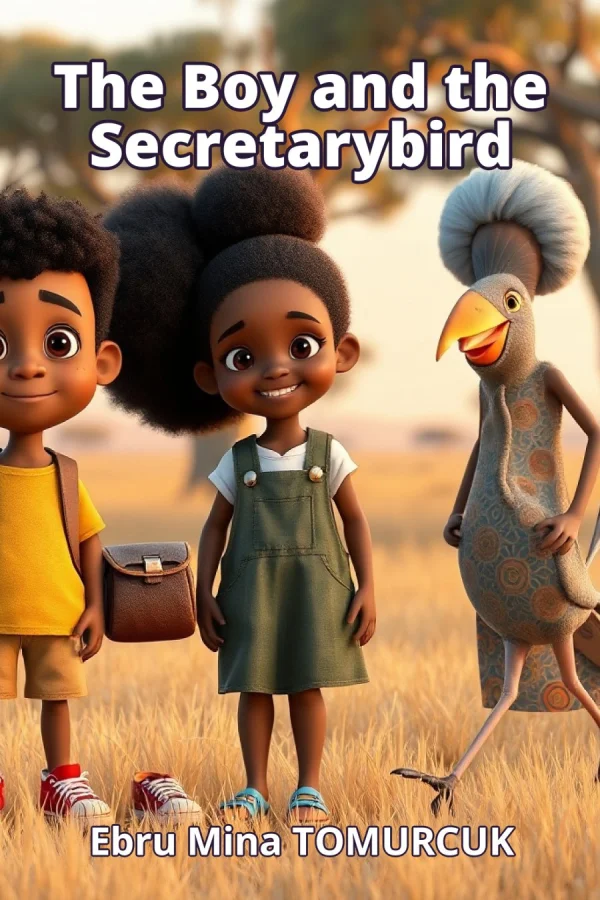
The Boy and the Secretarybird
Ebru Mina TOMURCUK
- Category Children's Fairy Tales
- Format PDF
- Size 12.6 MB
- Views 1
Kito is a nine-year-old boy who lives at the edge of the savanna, where acacia trees spread wide and the grass whispers in the wind. He carries a sketchbook and pencils everywhere and spends his mornings on a smooth rock, drawing the birds around him: hornbills with curved beaks, speckled guinea fowl, tiny waxbills that flicker like sparks. One tall bird with long pinkish-grey legs and a crest of black feathers makes him stop and stare. With his best friend Nia and his grandmother Amara, he learns that the bird is a secretarybird, and Nia spots the small blue band on its leg that gives the bird its name, Seka.
Inspired by Seka, Kito starts the Savanna Bird Project, determined to study and draw every unusual bird on the grassland. As he and Nia follow Seka, they watch her sharp amber eyes find a grasshopper and her long legs stomp it into the ground. They observe a kestrel hovering and dropping like a stone, and a flock of guinea fowl where one bird stands guard while the others eat. Each drawing gains notes and arrows, and Grandmother Amara explains that these different adaptations help each bird live and grow.
The project grows into a shared classroom effort, but a strong wind lifts the finished pages into the air. Kito and Nia must use what the birds taught them, working as a team to rescue the drawings. The story follows a curious young artist learning from the wildlife around him and discovering that observation and cooperation go hand in hand. It suits young readers who enjoy nature, drawing and gentle stories about friendship and family.
Read the Book
If the PDF does not appear, open it in a new tab.
A Chapter from the Book
The Boy and the Secretarybird - Author : Ebru Mina TOMURCUK
Kito lived at the edge of the savanna, where acacia trees spread wide and the grass whispered in the wind. He was nine years old, small and wiry, with warm brown skin, tight black coils of hair, and freckles across his nose. In his canvas satchel he carried a sketchbook and pencils. He loved drawing the unusual birds that swooped and strutted across the grassland. 1
Every morning, Kito sat on a smooth rock and watched the birds. He drew hornbills with curved beaks, guinea fowl with speckled feathers, and tiny waxbills that flickered like sparks. He filled page after page with wings and legs and tails. But one tall bird made him stop and stare. It had long pinkish-grey legs and a crest of black feathers. It walked proudly across the grass. 2
Kito's best friend Nia found him sketching. She was ten, tall and sturdy, with two puffy afro puffs and a gap-toothed grin. 'What are you drawing today?' she asked. 'That tall bird with the funny crest,' Kito said. 'It's called a secretarybird,' said Grandmother Amara, coming up behind them. She carried a wooden walking stick and wore her orange and blue patterned dress. Her silver hair was wrapped in a cloth. 3
Grandmother Amara told them about the secretarybird. 'She has the sharpest eyes,' she said. 'She can spot a grasshopper from far away. Her long legs let her walk for miles and stomp on prey.' Kito drew quickly, his dark brown eyes wide. Nia pointed at the small blue band on the bird's leg. 'Look, she's marked,' Nia said. 'We can call her Seka.' Kito smiled and added the band to his drawing. 4
That night, Kito had an idea. He would start a wildlife illustration project. He would study every unusual bird in the savanna and draw each one. Nia nodded. 'I'll help,' she said. 'We can make a big book and show everyone.' Kito's red sneakers tapped with excitement. He pulled out his sketchbook and wrote in big letters: THE SAVANNA BIRD PROJECT. 5
The next day, Kito and Nia followed Seka the secretarybird. They watched her stride through the grass on her long legs. Suddenly, she stopped and tilted her head. Her sharp amber eyes fixed on something small and brown. Then—stomp!—her foot hit the ground. She swallowed a grasshopper in one quick gulp. Kito sketched every move. 'Her legs are like walking sticks,' Nia said. 'And her eyes are like telescopes,' Kito added. 6
They found other birds too. A kestrel hovered high above, its sharp eyes scanning the grass. It dropped like a stone and caught a mouse. 'Sharp eyes help it hunt,' Kito said, drawing the kestrel's pointed wings. Then they saw a flock of guinea fowl pecking together. One bird stood guard while the others ate. 'They work together,' Nia said. 'Teamwork!' Kito drew the guard bird standing tall. 7
Kito's sketchbook filled with birds of every kind. Each bird had its own way to survive. The secretarybird had long legs and sharp eyes. The kestrel had keen sight. The guinea fowl had teamwork. Kito drew arrows and notes beside each picture. He showed Grandmother Amara his drawings. 'You see,' she said, 'different adaptations help each bird live and grow.' Kito nodded. His project was growing too. 8
At school, Kito told his classmates about the project. 'We want to make a big book of savanna birds,' he said. 'Can you help?' Everyone cheered. They drew birds, wrote facts, and painted backgrounds. Nia organized the pages. Kito drew the main pictures. The classroom filled with color and chatter. The project was becoming a happy celebration of nature. 9
One afternoon, a strong wind blew across the savanna. It rattled the windows and bent the acacia trees. Kito and Nia were outside with their drawings. A gust lifted the pages into the air! 'Oh no!' cried Kito. Pages swirled everywhere—birds flying away on the wind. Kito ran after them, his red sneakers kicking up dust. Nia chased a page that tumbled toward a thornbush. 10
Nia stopped and shouted, 'Wait! Let's work together like the guinea fowl!' Kito skidded to a halt. 'One guard, one gatherer!' he said. Nia nodded. 'You stand on the rock and spot the pages. I'll catch the ones that land.' So Kito climbed up and pointed. 'Over there! Behind the acacia! Near the fence!' Nia ran and gathered every page. They worked as a team, just like the birds they studied. 11
Grandmother Amara saw them from the porch. She smiled her gentle smile. 'Just like the secretarybird,' she said. 'Sharp eyes and quick legs—and teamwork.' They stacked the rescued pages and counted them. One page was still missing—the drawing of Seka. Kito's shoulders drooped. 'We'll find it,' Nia said. 'We'll search together.' She took his hand, and they walked back toward the savanna. 12
High in an acacia tree, something fluttered. Kito looked up. His drawing of Seka was caught in the branches, waving like a flag. Nia found a long stick. 'Your turn to climb,' she said. Kito climbed carefully while Nia held the stick steady. He reached out and grabbed the page. Seka the secretarybird walked by and tilted her head, as if to say, 'Well done.' Kito laughed with relief. 13
They brought the rescued pages inside, and the whole class helped put the book together. Grandmother Amara brought glue and ribbon. Every page was in its place. The book was called 'Birds of the Savanna.' On the last page, Kito wrote: 'Different birds have different ways to survive.
This section is a preview taken from the book (about 937 words). To continue, read the book or download the PDF.
Book Details
- Book
- The Boy and the Secretarybird
- Author
- Ebru Mina TOMURCUK
- Category
- Children's Fairy Tales
- Language
- English
- Format
- PDF · 12.6 MB
- Pages
- 18
- Words
- about 1,092
- Published
- onlinemasal.com.tr
- Access
- Free to read and download; for personal use only, all rights belong to the author.
Frequently Asked Questions
Is the PDF of The Boy and the Secretarybird free?
Yes. The Boy and the Secretarybird can be read and downloaded for free on this site; no sign-up or payment is required.
How many pages is The Boy and the Secretarybird?
The Boy and the Secretarybird has 18 pages and about 1,092 words.
Which devices can I read The Boy and the Secretarybird on?
It is a PDF; you can read it in your browser on a phone, tablet or computer, or download it and open it offline.
Who is the author of The Boy and the Secretarybird?
The Boy and the Secretarybird was written by Ebru Mina TOMURCUK; it is listed in the Children's Fairy Tales category.