The Boy and the Saiga
Ebru Mina TOMURCUK
- Category Children's Fairy Tales
- Format PDF
- Size 11.1 MB
- Views 2
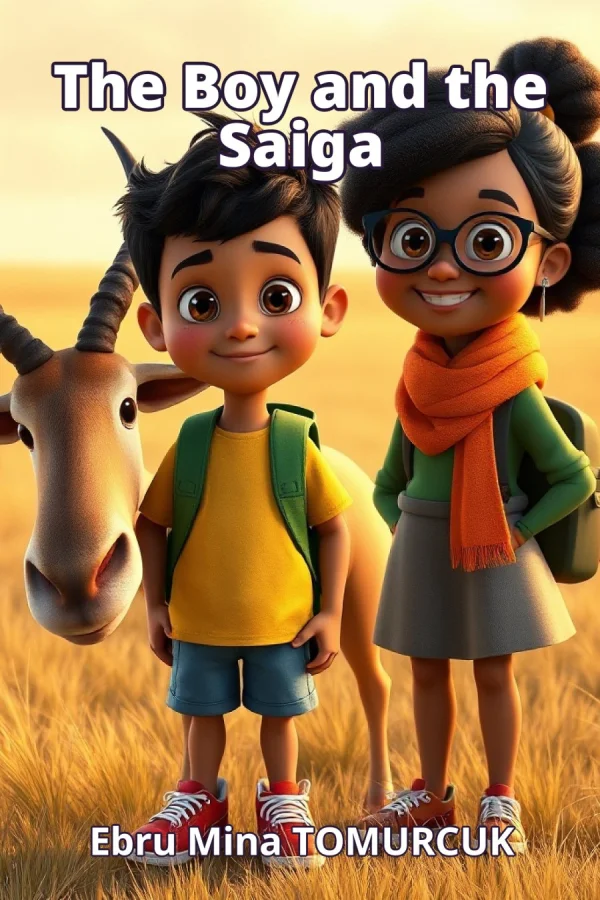
Leo loves the wide, open grassland near his home, and on a Saturday morning he pulls on his red sneakers and green backpack to explore it as usual. But this time something new stands quietly in the tall grass: an animal he has never seen, with a sandy tan coat, short curved horns, and a huge, droopy nose that hangs down past its mouth. Instead of running away, the creature sniffs the dusty air and nibbles a small plant, and Leo sits very still, watching and sketching it in his notebook.
At school, his teacher Mrs. Amara recognises the drawing and tells him it is a saiga, a kind of antelope that lives on the grassland. She explains why its long, flexible nose matters: it warms the cold air in winter and filters out dust in summer, so the animal can breathe safely when the wind blows hard. Leo is delighted, calling the nose a superhero mask, and he returns to the grassland with his notebook to record everything he sees, from a fat lizard and tiny flowers to grasshoppers and a circling hawk. He begins to understand biodiversity, the idea that many living things share one place and depend on one another.
When Leo learns that the grassland is shrinking and the animals are losing their homes, he asks what he can do. Mrs. Amara suggests telling others what he has learned, so he spends the week painting the saiga and preparing a presentation for his classmates. The book follows his quiet discovery, his curiosity and his first steps in speaking up for nature, and it is suited to young readers who are beginning to learn about animals, habitats and caring for the environment.
Read the Book
If the PDF does not appear, open it in a new tab.
A Chapter from the Book
The Boy and the Saiga - Author : Ebru Mina TOMURCUK
Leo loved wide, open places. On Saturday mornings, he pulled on his red sneakers and green backpack and raced across the grassland near his home. The wind blew dust into curly black hair and across his freckled nose. He liked to watch beetles crawl and birds swoop. But today, something new stood quietly in the tall grass, and Leo stopped to stare. 1
It was an animal he had never seen before. It was about as tall as his waist, with a sandy tan coat and short, curved horns. Its dark eyes blinked gently at him. But the strangest part was its nose. It was huge and droopy, like a soft little trunk hanging down past its mouth. Leo whispered, "What a funny nose you have!" 2
The animal did not run away. It sniffed the dusty air through its long, flexible nose and snorted softly. Leo sat very still in the warm yellow grass. Bees hummed, and the wind whispered through the stems. He watched the creature nibble a small green plant. "I wonder what you are," Leo said, pulling out his notebook. He drew the funny nose first, then the horns, then the tan coat. 3
At school, Leo showed his drawing to Mrs. Amara. She wore her bright orange scarf and round glasses, and she smiled her warm smile. "That looks like a saiga," she said. "It is a kind of antelope that lives on the grassland. Its nose is special. Would you like to learn more?" Leo nodded so fast his curly hair bounced. He wanted to know everything about this remarkable animal. 4
Mrs. Amara opened a big book full of pictures. "Saigas live in dusty, windy places," she explained. "Their long noses warm the air in winter and filter out dust in summer. When the wind blows hard, the saiga can breathe safely." Leo traced the picture with one finger. "So its funny nose is like a superhero mask!" he said. Mrs. Amara laughed and nodded. "Exactly," she said. "Nature is full of clever adaptations." 5
That afternoon, Leo went back to the grassland with his notebook and pencil. He saw the saiga again, wandering slowly through the grass. He noticed other things too. Tiny flowers grew between the rocks, and a fat lizard sunned itself on a stone. Grasshoppers leaped, and a hawk circled high above. "All of this is one big family," Leo thought. "The saiga needs the plants, and the plants need the soil, and everything fits together." 6
Leo wrote down everything he saw. He drew the saiga's nose, the lizard, the flowers, and the hawk. He counted six different kinds of birds and three kinds of insects. His green backpack grew heavy with notes, but he did not mind. "Biodiversity means many living things together," he said out loud. The word felt big and important in his mouth. He liked how it sounded, and he wanted to understand it better. 7
At home, Leo asked his family to help him find more facts. Together they learned that saigas travel in herds and eat many kinds of plants. They learned that the grassland gives homes to foxes, eagles, and tortoises. "Every animal matters," Leo wrote in his notebook. He underlined the words twice. But then he read something sad. The grassland was getting smaller, and the animals were losing their homes. Leo frowned and tapped his pencil. 8
"What can I do?" Leo asked Mrs. Amara the next morning. She straightened her glasses and kneeled beside his desk. "You can tell others what you learned," she said gently. "When people know how wonderful nature is, they want to protect it." Leo's dark brown eyes grew wide. "I could make a presentation!" he said. "I could show my drawings and explain why the grassland needs our help." Mrs. Amara clapped her hands softly. 9
Leo worked all week on his presentation. He painted a big picture of the saiga with its funny trunk nose. He wrote short sentences about how the nose filters dust and warms the cold air. He drew the lizard, the hawk, and the tiny flowers too. "I will show how all these living things make nature rich and wonderful," he told his mom. She helped him glue the pictures onto a big board, and he practiced speaking slowly and clearly. 10
On Friday, Leo stood in front of his classmates. His yellow tshirt felt bright and brave. His hands shook just a little, but he took a deep breath. "This is a saiga," he said, pointing to his painting. "It lives on the grassland. Its nose looks funny, but it helps the saiga breathe in dusty, windy places." The class leaned forward. Some children giggled at the long nose, but their eyes were curious and bright. 11
Leo turned the page of his board. "The saiga does not live alone," he said. "It shares the grassland with lizards, birds, flowers, and insects. Each one has a special way to survive. When we save the grassland, we save all of them together." He showed a picture of the wide, windy plains and the animals that live there. "Nature is wonderful because it is full," he said. "Full of different lives." 12
The classroom was silent for one long moment. Then a girl in a red sweater raised her hand. "I did not know a nose could do all that," she said. "That is amazing!" Another boy nodded. "I want to see a saiga someday," he said. Mrs. Amara smiled so big that her glasses slid up her nose. "You see, Leo?" she said softly.
This section is a preview taken from the book (about 944 words). To continue, read the book or download the PDF.
Book Details
- Book
- The Boy and the Saiga
- Author
- Ebru Mina TOMURCUK
- Category
- Children's Fairy Tales
- Language
- English
- Format
- PDF · 11.1 MB
- Pages
- 18
- Words
- about 1,163
- Published
- onlinemasal.com.tr
- Access
- Free to read and download; for personal use only, all rights belong to the author.
Frequently Asked Questions
Is the PDF of The Boy and the Saiga free?
Yes. The Boy and the Saiga can be read and downloaded for free on this site; no sign-up or payment is required.
How many pages is The Boy and the Saiga?
The Boy and the Saiga has 18 pages and about 1,163 words.
Which devices can I read The Boy and the Saiga on?
It is a PDF; you can read it in your browser on a phone, tablet or computer, or download it and open it offline.
Who is the author of The Boy and the Saiga?
The Boy and the Saiga was written by Ebru Mina TOMURCUK; it is listed in the Children's Fairy Tales category.