The Boy and the Rockhopper
Ebru Mina TOMURCUK
- Category Children's Fairy Tales
- Format PDF
- Size 12.0 MB
- Views 2
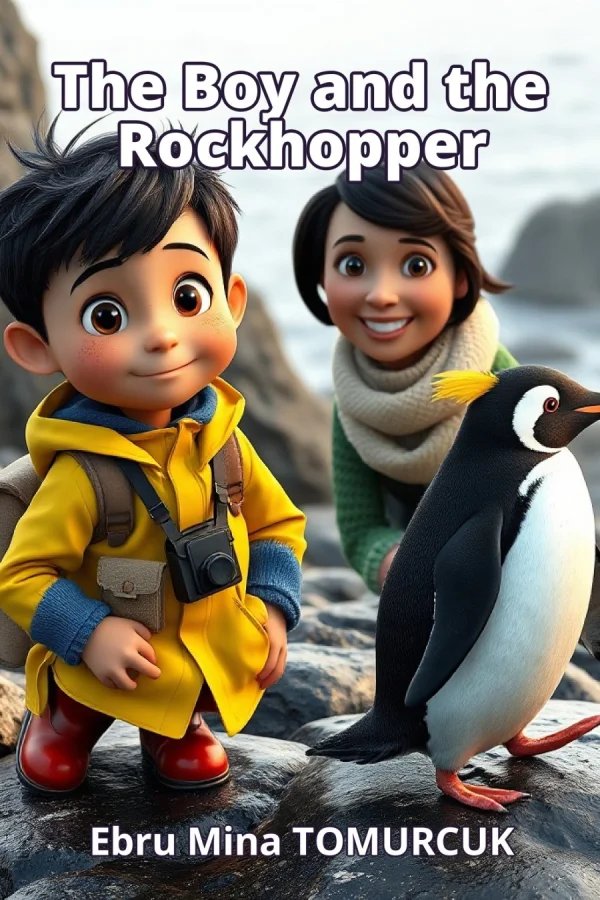
On a windy morning on the rocky coast, a boy in a bright yellow raincoat watches a rockhopper penguin hop from stone to stone. With his notebook in hand and his mother beside him holding a thermos, he begins to sketch the penguin's sharp black beak, white belly and yellow crest feathers. When he asks why rockhoppers hop instead of waddle, his mother simply tells him to watch their feet, and the boy starts to understand how the bird balances on uneven, slippery rocks with strong legs and tiny jumps. Over many mornings he fills his notebook with observations about how the penguins spread their wings for balance, huddle against the cold wind and puff up their dense feathers for warmth.
Inspired by what he has learned, the boy decides to share it by building a wildlife model of the rocky coast. With his mother's help he gathers safe materials such as smooth stones, twigs, moss and clay, then shapes clay penguins in hopping poses, adds arrows showing the direction of each hop and labels the model as a place built for rocky coasts. He goes on to add a sandy beach and an icy area, comparing how different penguins are suited to different homes. When his teacher invites him to bring the model to school, he explains each part to his classmates.
When a strong wind knocks some of the penguins over, the boy learns to rebuild and keep trying, just as the penguins adapt to their environment. The story is a gentle introduction to animal adaptation, observation and caring for nature, suited to young readers and to adults reading aloud with them.
Read the Book
If the PDF does not appear, open it in a new tab.
A Chapter from the Book
The Boy and the Rockhopper - Author : Ebru Mina TOMURCUK
On a windy morning, the boy in the bright yellow raincoat stood on the rocky coast. He watched a rockhopper penguin hop from stone to stone. The penguin had yellow crest feathers and bright red eyes. Its short, thick legs pushed it up, and its pinkish feet gripped the rock. The boy pulled out his notebook and wrote: Rockhoppers hop! 1
The boy's mum stood nearby in her green cardigan, holding a thermos. She smiled as he sketched the penguin's sharp black beak and white belly. 'Why do they hop instead of waddle?' he asked. 'Watch their feet,' Mum said. The boy saw how the penguin balanced on the uneven rocks, using its strong legs and tiny jumps. He drew arrows showing each hop. 2
The boy spent many mornings on the rocky coast, watching the rockhoppers. He noticed how they kept their balance on slippery stones, spreading their wings like little arms. He saw how they huddled together when the cold wind blew, their dense feathers puffed up for warmth. In his satchel, his notebook filled with sketches and notes about their rocky coast home. 3
One day, the boy decided to share what he had learned. He would build a wildlife model of the rocky coast, with pretend penguins and their habitats. Mum helped him gather safe materials: smooth stones, twigs, moss, and clay. 'Let's make it look just like the real place,' he said. He set up a cardboard base and started arranging the rocks. 4
The boy shaped a rocky shore from clay and stones. He made tiny rockhopper penguins from clay, painting their black backs and white bellies. With a fine brush, he added bright yellow crest feathers above their eyes. He gave them short, thick legs and pinkish feet. 'Now they need a habitat,' he said, and he placed moss and seaweed around the rocks. 5
As he built, the boy remembered how the real penguins hopped over rocks. He made his model penguins in hopping poses, using toothpicks to hold them up. He showed how their strong legs pushed off from the rocks. He added tiny arrows on the base to show the direction of each hop. 'Hopping is their adaptation,' he told Mum. 'It helps them move on rocky ground.' 6
Mum handed him a small fan. 'Let's test how they stay warm in cold winds,' she said. The boy turned on the fan, and the model penguins stood firm, their clay feathers packed close. He explained, 'Their dense feathers trap heat, and their strong legs keep them steady.' He wrote a label for the model: Rockhopper Penguins—Built for Rocky Coasts. 7
The boy wanted his model to show other habitats, too. He built a sandy beach with pretend penguins that waddled, and an icy area with penguins that slid on their bellies. 'Different places need different adaptations,' he said. He compared the rockhoppers' strong legs with the sandy-beach penguins' lighter feet. His model grew into a whole wildlife park. 8
Word spread about the boy's model. His friends came to see the rocky coast, the sandy beach, and the icy world. The boy showed them how the rockhoppers hopped and balanced. 'Their yellow crest feathers make them easy to spot,' he said. 'And their red eyes help them see in dim light.' His friends were amazed at how each penguin was suited to its home. 9
The boy's teacher asked him to bring the model to school. He carefully carried it in a box, with Mum's help. In class, he set it on a table and explained each part. 'Rockhoppers have strong legs for hopping and special feathers for warmth,' he said. 'Their habitat is rocky, so they need to be tough and steady.' The class clapped and asked questions. 10
One day, a strong wind blew through the boy's model, knocking over some penguins. He felt upset, but Mum said, 'Let's fix it together.' They rebuilt the rocky coast, making the stones more secure. The boy realized that just like the penguins, he needed to adapt and keep trying. He added a tiny sign: Please touch gently—penguins at work! 11
The boy learned that even models need care. He covered the model with a cloth when not in use. He checked the clay penguins for cracks and repainted a faded crest. 'Taking care of nature is important, too,' he said. 'Real rockhoppers need clean coasts and safe places to live.' He decided to tell others about protecting penguin habitats. 12
The boy's model won a prize at the school science fair. He stood proudly in his yellow raincoat as visitors admired the rocky coast. He explained how rockhoppers hop, balance, and stay warm. 'Different habitats require different adaptations,' he said. 'That's what makes nature so amazing.' His notebook was full, but his curiosity was even bigger. 13
Back on the real rocky coast, the boy watched the rockhoppers again. He felt he understood them better now. The penguins hopped and balanced just as his model showed. He knew that his model helped others see how special these birds are. He smiled, thinking of all the fun he had learning and sharing. 14
Mum took a photo of the boy with his model for the family album. 'You've taught us so much about penguins,' she said. The boy hugged her. He knew that learning could be fun, especially when you share it. His model stood as a reminder that every habitat has its own challenges and every animal has its own clever adaptations.
This section is a preview taken from the book (about 930 words). To continue, read the book or download the PDF.
Book Details
- Book
- The Boy and the Rockhopper
- Author
- Ebru Mina TOMURCUK
- Category
- Children's Fairy Tales
- Language
- English
- Format
- PDF · 12.0 MB
- Pages
- 18
- Words
- about 991
- Published
- onlinemasal.com.tr
- Access
- Free to read and download; for personal use only, all rights belong to the author.
Frequently Asked Questions
Is the PDF of The Boy and the Rockhopper free?
Yes. The Boy and the Rockhopper can be read and downloaded for free on this site; no sign-up or payment is required.
How many pages is The Boy and the Rockhopper?
The Boy and the Rockhopper has 18 pages and about 991 words.
Which devices can I read The Boy and the Rockhopper on?
It is a PDF; you can read it in your browser on a phone, tablet or computer, or download it and open it offline.
Who is the author of The Boy and the Rockhopper?
The Boy and the Rockhopper was written by Ebru Mina TOMURCUK; it is listed in the Children's Fairy Tales category.