The Boy and the Mudskipper
Ebru Mina TOMURCUK
- Category Children's Fairy Tales
- Format PDF
- Size 11.2 MB
- Views 2
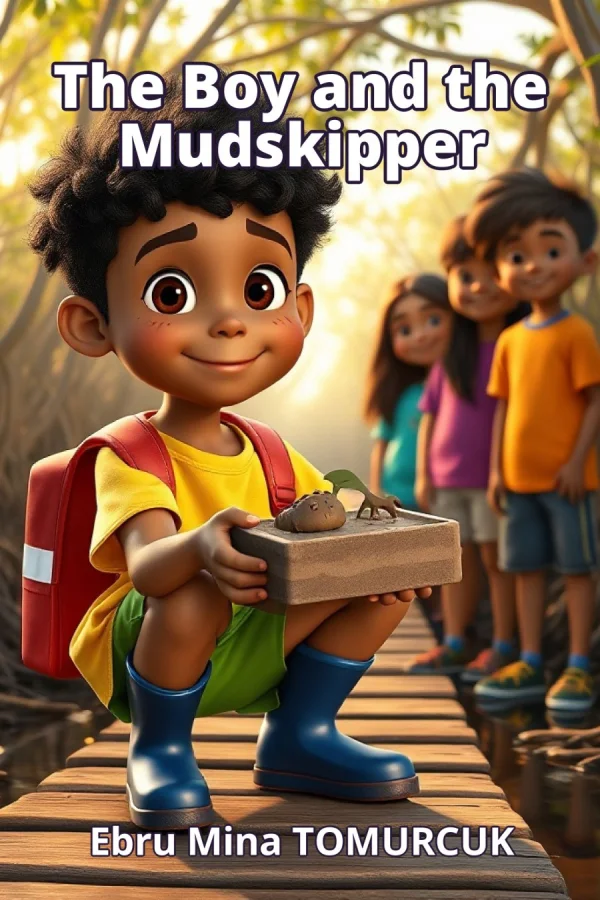
Sam is a curious boy who loves finding out how animals work, so on a bright Saturday morning he pulls on his blue rubber boots and heads to the mangrove by the bay with a notebook in his pocket. Among the tangled roots and salty mud he spots something surprising: a fish that pushes itself up on strong front fins and shuffles across the mud like a tiny lizard, its bulging eyes swiveling on top of its head. A park ranger named Mr. Lee explains that this is a mudskipper, a fish that can spend time out of water, breathing through its skin and the water it holds in its mouth.
Sam spends the morning sketching the mudskipper as it skips after bugs, hops with a flick of its tail and darts into a burrow when a shadow passes. Back home he turns what he has learned into a shoebox model of the mangrove habitat, shaping mud from clay, twigs and paint and adding a clay mudskipper with two little bumps for eyes. At school he explains his model to his friends Mia, Leo and Zoe and then to the whole class, and afterwards the children visit the mangrove together to watch the real fish appear from its burrow.
The story follows one boy's close observation of a single animal and shows how careful looking turns into understanding, and how that understanding can be shared with others. Young readers learn how a mudskipper's fins, eyes and skin help it live in mud and shallow water, and what a mangrove habitat provides for the creatures in it. It suits children who enjoy nature, simple science and stories about curiosity, and it works well read aloud or explored independently.
Read the Book
If the PDF does not appear, open it in a new tab.
A Chapter from the Book
The Boy and the Mudskipper - Author : Ebru Mina TOMURCUK
On a bright Saturday morning, Sam pulled on his blue rubber boots and grabbed his red backpack. He was going to the mangrove by the bay, where the trees grew right out of the water. His notebook was tucked in his pocket, ready for sketches. Sam loved finding out how things worked, especially animals. Today, he hoped to see something new. 1
The mangrove was a tangle of roots and mud, buzzing with tiny crabs and chirping birds. Sam stepped carefully along the boardwalk, peering into the shallow water. The air smelled salty and green. He crouched down to watch a crab wave its claw. Then something splashed near a root, and Sam froze. A fish was flopping onto the mud! 2
But this fish didn't just flop. It pushed itself up on two strong front fins and shuffled forward like a tiny lizard. Its bulging eyes sat on top of its head, swiveling this way and that. Sam gasped. "You can walk!" he whispered. The fish's mottled brown and green skin blended with the mud. It looked like a walking, blinking pebble. 3
The mudskipper paused, flicked its tail, and then scooted across the mud on its fin-legs. Sam followed quietly, his boots squelching. The fish left a little trail of prints, like tiny finger marks. It stopped by a puddle and gulped water. Sam opened his notebook and sketched the funny fish. He wrote: "Mudskipper walks on fins. Eyes on top. Lives in mud." 4
A park ranger named Mr. Lee walked by and saw Sam watching. "That's a mudskipper," he said with a smile. "It's a fish that can live out of water for a while. Its fins work like legs, and it can breathe through its skin and the water it holds in its mouth." Sam's eyes went wide. "So it's adapted to the mud!" he said. Mr. Lee nodded. "Exactly." 5
Sam spent the whole morning watching the mudskipper. It skipped over the mud to catch tiny bugs. It flipped its tail to hop. When a shadow passed, it darted into a burrow. Sam noticed how its eyes stayed above the mud like periscopes. He drew the roots around it, the shallow water, and the muddy bank. His notebook filled with sketches and notes. 6
On the way home, Sam's head was full of ideas. He wanted to show his friends how clever the mudskipper was. "I could build a model," he thought. "A model of the whole mangrove habitat!" He imagined mud, roots, water, and a little mudskipper in the middle. At home, he gathered a shoebox, clay, twigs, and paint. His mom gave him an old sponge for mud. 7
Sam worked all afternoon. He mixed brown paint with sand to make mud. He twisted twigs into arching roots. He painted a blue puddle for water. For the mudskipper, he used clay, with two little bumps for eyes on top. He added tiny fins for legs. The model grew more real with every piece. Sam's tongue stuck out as he concentrated. 8
The next day, Sam carried his model to school in a box. His friends, Mia, Leo, and Zoe, gathered around his desk. "What is it?" asked Mia, her ponytail swinging. Sam set the model down gently. "It's a mangrove habitat," he said. "And this is a mudskipper." He pointed to the clay fish with its bulging eyes. 9
Sam explained how the mudskipper walks on its fins and breathes through its skin. "Its eyes are on top so it can watch for danger while hiding in the mud," he said. His friends leaned in close. "That's amazing!" said Leo, his red hair flopping. Zoe, in her teal shirt, asked, "Can it really walk?" Sam nodded. "I saw it with my own eyes." 10
Then Sam showed them the roots he had made from twigs. "The roots hold the mud together and give the fish a place to hide," he said. He let each friend touch the model. Mia gently touched the clay mudskipper. "It feels bumpy," she said. Sam smiled. "That's its camouflage. It blends in with the mud so predators can't see it." 11
Mrs. Chen, the teacher, came over to see. "Sam, this is wonderful," she said. "You've shown how a habitat works." She asked Sam to tell the whole class. Sam's heart beat fast, but he stood up and spoke clearly. He told them about the mangrove and the funny fish that walks on mud. The class clapped, and Sam felt proud. 12
After school, Sam and his friends went to the mangrove together. Sam showed them where he had seen the mudskipper. They waited quietly. Soon, a little head with bulging eyes popped out of a burrow. The mudskipper skipped across the mud, its fin-legs moving fast. "There it is!" whispered Zoe. They watched until it plopped back into the water. 13
On the way home, Leo said, "I want to build a model too." Mia wanted to draw the mudskipper. Sam felt happy. He had shared something he loved, and his friends were excited too. "Nature is full of surprises," he said. "You just have to look closely." They all agreed to visit the mangrove again soon. 14
That evening, Sam set his model on a shelf in his room. He looked at the clay mudskipper with its fin-legs and bulging eyes. He thought about how many ways animals adapt to their homes. "There are so many more things to discover," he said to himself. He picked up his notebook and started a new page, ready for the next adventure.
This section is a preview taken from the book (about 942 words). To continue, read the book or download the PDF.
Book Details
- Book
- The Boy and the Mudskipper
- Author
- Ebru Mina TOMURCUK
- Category
- Children's Fairy Tales
- Language
- English
- Format
- PDF · 11.2 MB
- Pages
- 18
- Words
- about 997
- Published
- onlinemasal.com.tr
- Access
- Free to read and download; for personal use only, all rights belong to the author.
Frequently Asked Questions
Is the PDF of The Boy and the Mudskipper free?
Yes. The Boy and the Mudskipper can be read and downloaded for free on this site; no sign-up or payment is required.
How many pages is The Boy and the Mudskipper?
The Boy and the Mudskipper has 18 pages and about 997 words.
Which devices can I read The Boy and the Mudskipper on?
It is a PDF; you can read it in your browser on a phone, tablet or computer, or download it and open it offline.
Who is the author of The Boy and the Mudskipper?
The Boy and the Mudskipper was written by Ebru Mina TOMURCUK; it is listed in the Children's Fairy Tales category.