The Boy and the Marine Iguana
Ebru Mina TOMURCUK
- Category Children's Fairy Tales
- Format PDF
- Size 11.6 MB
- Views 1
On a sunny island in the middle of the sea, a curious boy named Leo lives in a small village. With his notebook and pencil always at hand, Leo explores the rocky shore, watching crabs scurry and seabirds dive. But one creature puzzles him more than any other: a dark, spiky lizard that swims in the sea. Determined to uncover its secret, Leo observes a large marine iguana resting on a black rock. When the iguana slips into the water, Leo follows its movements and discovers that it dives underwater to nibble algae from the rocks. Amazed, he records his findings and seeks answers from his grandfather, who explains the concept of adaptation and evolution.
As Leo learns how the marine iguana's strong tail, sharp claws, and ability to hold its breath are shaped by evolution, he becomes eager to share his discovery. He spends days sketching the island's animals and writing about how each one fits into the ecosystem. With his family's encouragement, Leo prepares a presentation for his class, where he explains how the iguana's unique adaptations help it survive. His enthusiasm sparks curiosity among his classmates, and Leo feels proud to have shared his knowledge.
This children's fairy tale teaches young readers about adaptation, evolution, and the interconnectedness of life. Through Leo's eyes, readers learn that every living thing has a special place in its ecosystem. The story is ideal for children aged 6 to 10, offering a gentle introduction to scientific concepts in an engaging narrative. It encourages observation, curiosity, and a deeper appreciation for nature's wonders.
Read the Book
If the PDF does not appear, open it in a new tab.
A Chapter from the Book
The Boy and the Marine Iguana - Author : Ebru Mina TOMURCUK
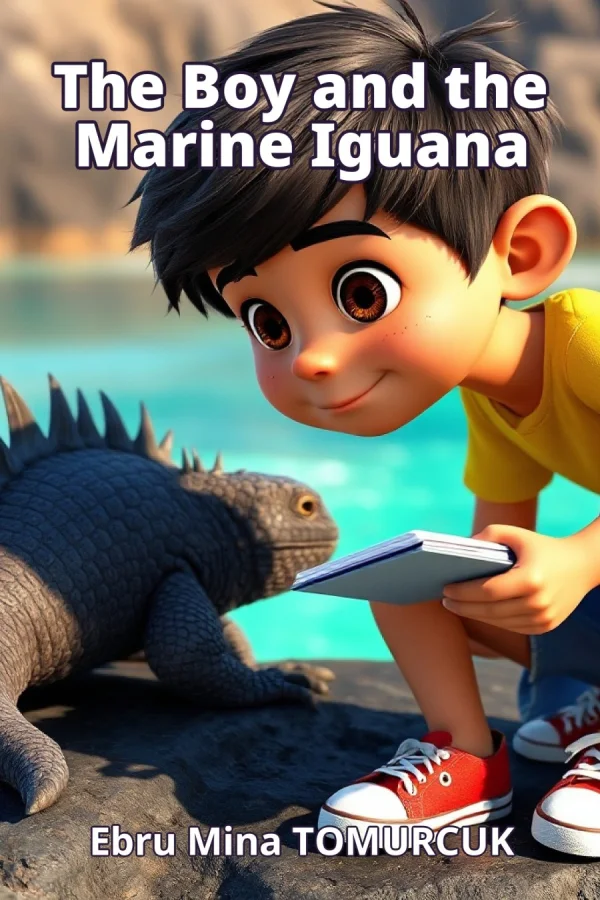
On a sunny island in the middle of the sea, a boy named Leo lived in a small village. He had warm tan skin, messy dark brown hair, and large curious brown eyes. Freckles were scattered across his nose like tiny stars. Every day, Leo carried a small notebook and a pencil tucked in his pocket, ready to explore. 1
Leo loved to wander along the rocky shore. He watched crabs scurry and seabirds dive. But one creature puzzled him more than any other. It was a lizard, dark and spiky, yet it swam in the sea. Leo had seen it slip into the waves and vanish. "How can a lizard swim?" he wondered. 2
The island was a special place. Giant tortoises roamed the hills, and bright fish darted in the bay. But the marine iguana was the strangest of all. It had a blunt, dragon-like snout and a crest of spines along its back. Its dark scales were patched with faint red and green. Leo wanted to know its secret. 3
One morning, Leo spotted a large marine iguana resting on a black rock. It was about a metre long from snout to tail. Its amber eyes were calm and patient. Leo crouched low and kept still. He took out his notebook. The iguana blinked but didn't move. "Hello," Leo whispered. "I won't hurt you." 4
The iguana turned its head toward the water. Then, with a slow push of its strong claws, it slipped off the rock and into the sea. Leo gasped. The reptile swam with powerful strokes of its long tail. Its spiky crest cut through the water like a little dragon. Leo watched, amazed, as it dove deeper and deeper. 5
Underwater, the marine iguana nibbled algae from the rocks. It scraped the green food with its blunt snout. Leo couldn't believe his eyes. A lizard eating seaweed! The iguana stayed under for a long time, then swam back up to the surface. It climbed onto the rock and sneezed out salty water. Leo giggled. "You're full of surprises!" 6
Leo wrote in his notebook: "Marine iguana swims and eats algae." But why? He asked his grandfather, who knew everything about the island. "Long ago, iguanas lived on land," Grandpa said. "Some found food in the sea. Over many years, their bodies changed. That's called adaptation. It's evolution's way of helping animals fit their home." 7
Leo nodded. "So the iguana's swimming skill is an adaptation?" "Exactly," said Grandpa. "Its strong tail, its claws, its ability to hold its breath—all shaped by evolution. The iguana lives in its ecosystem, and the ecosystem lives in it." Leo's eyes grew wide. He wanted to tell everyone. He decided to make a presentation about the island and its animals. 8
Leo spent the next days exploring and sketching. He drew the marine iguana diving underwater. He drew the giant tortoises and the bright fish. He wrote about how each animal fits into the island ecosystem. The iguanas eat algae, the fish clean the sea, and the birds eat the fish. Everything is connected. Leo's notebook filled with pictures and words. 9
He practiced his presentation in front of his family. "The marine iguana is a reptile that swims in the sea," he said. "It nibbles algae underwater. This is an adaptation—a special skill shaped by evolution. Evolution produces unusual and wonderful adaptations!" His little sister clapped. His mother smiled. "You've learned so much, Leo." 10
On the day of the presentation, Leo stood in front of his class. His heart beat fast. He held up his drawing of the swimming iguana. "Imagine a lizard that dives like a fish," he began. The other children leaned forward. Leo told them about the spiky crest, the strong claws, and the salty sneeze. They laughed and asked questions. Leo answered them all. 11
He showed how the iguana's adaptation helps it survive. "It can eat food that other lizards can't reach," he said. "That's why it lives here, on this island. Evolution shaped its body to fit its home." His teacher nodded. "And that's how ecosystems work," she said. "Every living thing has its place." Leo felt proud. He had shared his discovery. 12
After school, Leo ran back to the rocky shore. The marine iguana was there again, basking in the sun. Leo sat quietly nearby and opened his notebook. He drew one more picture: the iguana swimming with its spiky crest and calm eyes. He wrote: "Adaptation is amazing." The iguana seemed to nod, then slipped into the waves. 13
Leo learned that day that evolution is full of surprises. A lizard that swims, a tortoise that walks slowly, a bird that dives— each one is a perfect fit for its island home. He looked at the marine iguana and smiled. "You're a wonder," he whispered. The iguana sneezed and shook its spiky head. Leo laughed. 14
He went home and told his grandfather everything. "You see," Grandpa said, "evolution produces unusual and wonderful adaptations. The marine iguana is living proof." Leo nodded. He knew he would keep exploring, keep asking questions, and keep writing in his notebook. The island was full of secrets, and he wanted to discover them all. 15
And so, on that sunny island, a boy and a marine iguana became friends in their own quiet way. Leo learned that even the strangest skills have a purpose. Evolution shapes life in wonderful ways, helping every creature fit its ecosystem. He smiled, tucked his notebook into his pocket, and ran home to plan his next adventure.
This section is a preview taken from the book (about 940 words). To continue, read the book or download the PDF.
Book Details
- Book
- The Boy and the Marine Iguana
- Author
- Ebru Mina TOMURCUK
- Category
- Children's Fairy Tales
- Language
- English
- Format
- PDF · 11.6 MB
- Pages
- 18
- Words
- about 941
- Published
- onlinemasal.com.tr
- Access
- Free to read and download; for personal use only, all rights belong to the author.
Frequently Asked Questions
Is the PDF of The Boy and the Marine Iguana free?
Yes. The Boy and the Marine Iguana can be read and downloaded for free on this site; no sign-up or payment is required.
How many pages is The Boy and the Marine Iguana?
The Boy and the Marine Iguana has 18 pages and about 941 words.
Which devices can I read The Boy and the Marine Iguana on?
It is a PDF; you can read it in your browser on a phone, tablet or computer, or download it and open it offline.
Who is the author of The Boy and the Marine Iguana?
The Boy and the Marine Iguana was written by Ebru Mina TOMURCUK; it is listed in the Children's Fairy Tales category.