The Boy and the Kakapo
Ebru Mina TOMURCUK
- Category Children's Fairy Tales
- Format PDF
- Size 12.9 MB
- Views 3
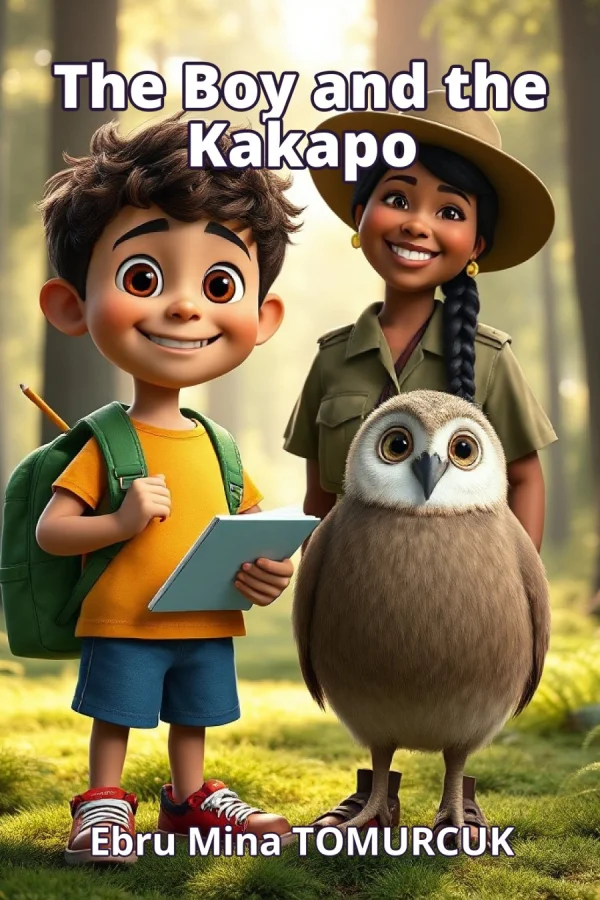
Eight-year-old Milo loves exploring, so one sunny Saturday he packs his sketchbook and pencil and heads into the quiet green forest to draw whatever he finds. A strange, deep booming sound rolls through the trees like a drum, and with the help of Ranger Hana, a friendly ranger in an olive-green uniform, Milo follows it to a mossy clearing. There he meets the strangest parrot he has ever seen: a round, plump kakapo with mossy green and yellow feathers, an owl-like face, stubby wings it never uses to fly, and a tiny leaf stuck on its head like a little hat.
Ranger Hana explains that the kakapo walks everywhere on strong legs and makes its booming call to reach other kakapos far away in the forest. She also tells Milo that kakapos are very rare and need people's help to stay safe. Moved by his gentle, funny new friend, Milo asks how he can help, and the ranger suggests the simplest and most powerful thing: telling others. Back home, Milo spends the afternoon drawing the kakapo on every page of a small booklet, adding bright, simple reminders to keep the forest green, stay quiet near nests and stay on the path.
The Boy and the Kakapo is a gentle story about curiosity, care for nature and the confidence of a child who discovers that sharing what he has learned can make a real difference. Through Milo's booklet, which travels from neighbors to a teacher, a park, a visitor center and a shop window, young readers see how one small act of attention can grow into wider concern for a rare bird and its forest. The tale suits children and anyone reading aloud who enjoys animal stories with a quiet conservation message.
Read the Book
If the PDF does not appear, open it in a new tab.
A Chapter from the Book
The Boy and the Kakapo - Author : Ebru Mina TOMURCUK
Milo was eight years old, with warm light-brown skin, short curly dark-brown hair and large hazel eyes. He loved exploring. One sunny Saturday, he pulled on his mustardyellow t-shirt, tied his red sneakers and packed his green backpack. He tucked a small sketchbook under his arm and a pencil behind his ear. Today, he was going into the forest to draw whatever he found. 1
The forest was green and quiet, full of tall trees and soft moss. Ferns curled like little green springs, and sunlight made spots on the path. Milo heard a strange, deep booming sound. Boom! Boom! It rolled through the trees like a drum. Milo stopped and listened. What kind of bird could make a sound like that? He walked slowly toward it, his heart going thump-thumpthump. 2
A tall ranger in an olive-green uniform stepped onto the path. She wore a wide-brimmed hat, and her long black braid swung as she walked. "Hello there," she said with a wide, friendly smile. "I'm Ranger Hana. Are you looking for something?" Milo told her about the booming sound. Her dark eyes twinkled. "Ah! Follow me. I know exactly who that is." 3
Ranger Hana led Milo to a mossy clearing. There, waddling over the roots, was the strangest parrot Milo had ever seen. It was round and plump, about the size of a large chicken, with mossy green and yellow feathers and brown speckles. Its face was pale and owl-like, with big dark eyes. A tiny leaf was stuck on its head like a little hat. 4
The kakapo blinked at Milo and took a wobbly step closer. Its short stubby wings flapped, but it did not fly. "Hello," Milo whispered. The parrot made a soft, gentle sound and tilted its head. Milo laughed. "You're funny! You look like a fuzzy green ball with a beak." The kakapo puffed itself up proudly, as if it agreed completely. 5
"This is a kakapo," Ranger Hana said quietly. "It's a parrot that cannot fly. It walks everywhere on its strong legs. It makes that booming call to find other kakapos far away in the forest." Milo opened his sketchbook and began to draw. He drew the round body, the big grey beak and the owl-like face. The parrot watched him, curious and calm. 6
"Are there many kakapos?" Milo asked. Ranger Hana shook her head. "Not many at all. They are very rare. They need our help to stay safe." Milo's pencil stopped. He looked at his new friend, so gentle and funny, and a warm, determined feeling grew inside him. "Then I want to protect him," Milo said. "But how can I help?" 7
Ranger Hana knelt beside him. "The best way is to tell people," she said. "When people know about kakapos and the forest, they care for them. You could make something to share what you've learned." Milo looked down at his sketchbook, at the drawing of the round green parrot. Slowly, a big, gap-toothed smile spread across his face. "I know what to make," he said. 8
Back home, Milo worked all afternoon. He drew the kakapo on every page, waddling and puffing and blinking its big eyes. He wrote simple words in bright letters: Kakapos are rare. Keep the forest green. Stay quiet near nests. He colored the pages cheerfully and stapled them together. It smelled of pencil and crayon, and it was full of his new friend. 9
The next day, Milo took his little booklet everywhere. He showed it to his neighbors, his teacher and the children at the park. "This is a kakapo," he told everyone. "It cannot fly, and it needs our help." People leaned in close to look at the drawings. They smiled at the round, funny parrot with the leaf on its head and asked lots of questions. 10
Ranger Hana helped him share the booklet at the forest visitor center. Visitors read it and learned how to care for the forest and its unusual birds. "Keep the trees safe," they read. "Pick up your litter. Stay on the path." A family promised to plant trees. A shop owner put a drawing in her window. The little booklet began to travel from hand to hand. 11
Weeks later, Milo returned to the mossy clearing. Ranger Hana was there, and more people were helping to look after the forest. The trees were green, the ferns were curling, and the path was tidy. Milo listened. He heard a soft rustle, then a gentle waddle. Out from the ferns came his friend, round and plump, with a fresh leaf stuck on its head. 12
The kakapo stopped beside Milo and blinked its big dark eyes. Milo sat very still. Then, deep and proud, the parrot boomed: Boom! Boom! It was the happiest sound Milo had ever heard. Ranger Hana laughed. "He's calling to his friends," she said. "Maybe he's telling them a kind boy helped keep his home safe." Milo beamed from ear to ear. 13
Milo opened his sketchbook and drew one last picture. He drew the kakapo standing tall on a mossy root, with the forest glowing bright and green all around. Underneath, he wrote: The forest is home to everyone. Keep it safe. He tucked the drawing into his pocket and walked home slowly, happy and proud. Protecting one little friend had made a big difference.
This section is a preview taken from the book (about 906 words). To continue, read the book or download the PDF.
Book Details
- Book
- The Boy and the Kakapo
- Author
- Ebru Mina TOMURCUK
- Category
- Children's Fairy Tales
- Language
- English
- Format
- PDF · 12.9 MB
- Pages
- 18
- Words
- about 1,039
- Published
- onlinemasal.com.tr
- Access
- Free to read and download; for personal use only, all rights belong to the author.
Frequently Asked Questions
Is the PDF of The Boy and the Kakapo free?
Yes. The Boy and the Kakapo can be read and downloaded for free on this site; no sign-up or payment is required.
How many pages is The Boy and the Kakapo?
The Boy and the Kakapo has 18 pages and about 1,039 words.
Which devices can I read The Boy and the Kakapo on?
It is a PDF; you can read it in your browser on a phone, tablet or computer, or download it and open it offline.
Who is the author of The Boy and the Kakapo?
The Boy and the Kakapo was written by Ebru Mina TOMURCUK; it is listed in the Children's Fairy Tales category.