The Boy and the Dugong
Ebru Mina TOMURCUK
- Category Children's Fairy Tales
- Format PDF
- Size 10.9 MB
- Views 2
Leo loves the ocean more than anything, and his favorite animal is the dugong, a gentle sea creature that grazes on seagrass. He carries a canvas tote bag with a seagrass drawing and keeps a notebook full of dugong facts, spending his afternoons watching videos and reading about these rounded, grey-brown animals that swim slowly with flipper-like limbs. When his teacher, Mr. Lee, invites him to share his knowledge with the class, Leo teams up with his best friend Mira to build a coastal habitat presentation complete with pictures, facts, and a small dugong model.
As they work, Leo discovers a troubling fact: seagrass meadows are shrinking because of pollution, careless boat anchors, and warming water. If the seagrass disappears, dugongs have no food. Leo and Mira turn their presentation into a call to action, explaining how seagrass holds sand in place, produces oxygen, and shelters baby fish, and how dugongs keep the meadows young and strong by grazing. Their classmates respond with questions and ideas, and the project grows into a Seagrass Club, a beach clean-up, and a field trip to a real seagrass meadow with a marine scientist.
The story follows Leo's curiosity from private fascination to shared responsibility, showing young readers how knowledge about a single animal can connect to a wider web of habitat, food, and community action. It is suited to children in early primary school, and to parents and teachers looking for a gentle introduction to ocean conservation that stays concrete and hopeful.
Read the Book
If the PDF does not appear, open it in a new tab.
A Chapter from the Book
The Boy and the Dugong - Author : Ebru Mina TOMURCUK
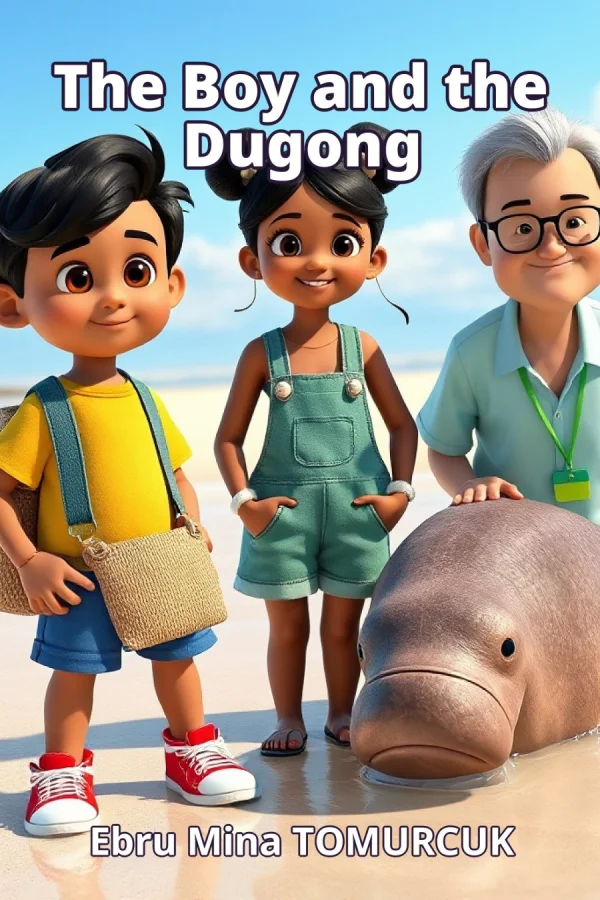
Leo loved the ocean more than anything. He had warm tan skin, wavy dark brown hair, and big curious brown eyes that sparkled when he talked about sea animals. His favorite animal was the dugong, a gentle sea creature that grazes on seagrass. Leo carried a canvas tote bag with a seagrass drawing everywhere he went. Inside, he kept a notebook full of dugong facts. 1
Every afternoon, Leo watched videos and read books about dugongs. He learned that dugongs are large, rounded animals with grey-brown skin and small friendly eyes. They use their flipper-like front limbs to swim slowly through the ocean. Dugongs love to munch on seagrass, which grows in sunny, shallow water. Leo thought they looked like underwater gardeners, keeping the seagrass neat and healthy. 2
One day, Leo's teacher, Mr. Lee, invited him to share his dugong knowledge with the class. Mr. Lee had a gentle smile and wore a green lanyard with a leaf badge. "Leo, would you like to teach us about these amazing animals?" he asked. Leo's bright smile stretched wide. "Yes! I'll make a coastal habitat presentation!" He couldn't wait to begin. 3
Leo asked his best friend Mira to help. Mira had deep brown skin and black hair in two puffy buns. She wore mint green overalls and a shell bracelet that clicked when she moved. "Let's build the best presentation ever!" she said. They gathered pictures, facts, and even a small model of a dugong. Leo drew a big seagrass meadow on a poster board, using bright green markers. 4
As they worked, Leo read a sad fact. Seagrass meadows were shrinking in many places. Pollution, careless boat anchors, and warming water were harming the underwater gardens. "If seagrass disappears, dugongs have no food," Leo said, his brown eyes wide with worry. Mira frowned. "We have to tell everyone!" They decided to make their presentation a call to action. 5
On presentation day, Leo stood in front of the class. His yellow t-shirt was bright, and his red sneakers tapped with excitement. He held up a picture of a dugong swimming among seagrass. "This is a dugong," he said. "It eats seagrass all day. Seagrass is like a big salad bar for the ocean!" The class giggled. Mira held up another picture showing how seagrass gives shelter to baby fish. 6
Leo explained that seagrass keeps the ocean healthy. Its roots hold the sand in place, and its leaves make oxygen. "Dugongs help seagrass by eating it," he said. "When they graze, they keep the meadow young and strong." Mr. Lee nodded, his glasses glinting. "That's a wonderful cycle," he said. The students leaned forward, curious and interested. 7
Mira asked the class, "Did you know that one dugong can eat a whole bathtub of seagrass in a day?" The students gasped. "That's a lot of salad!" someone shouted. Leo smiled. "But if the seagrass shrinks, dugongs go hungry. We need to protect the seagrass meadows." He showed a map of local coastal areas where seagrass was disappearing. 8
The class grew quiet. Then a girl named Ava raised her hand. "What can we do to help?" she asked. Leo's smile returned. "We can keep our beaches clean, so trash doesn't wash into the ocean. We can tell our families not to anchor boats on seagrass. And we can plant seagrass in safe places with adults." Mira added, "Even small actions make a big difference!" 9
Mr. Lee praised Leo and Mira. "You've taught us something important," he said. "Conservation starts with caring, and you've shown us how." The students clapped. Leo felt proud, but he knew the work was just beginning. He looked at Mira, and they shared a determined grin. "Let's make a promise," Mira said. "We'll protect the seagrass and the dugongs!" 10
The next week, the class started a Seagrass Club. They drew posters with dugongs and seagrass and hung them in the hallway. They organized a beach clean-up with their families. Leo brought his seagrass tote bag to carry gloves and bags. Mira made a list of all the trash they collected. "Look at all this!" she said, holding up a tangled fishing line. "We're making a difference." 11
One sunny Saturday, the class visited a seagrass meadow with a marine scientist. They learned how to identify healthy seagrass and how to spot problems. Leo saw a dugong swimming in the distance! Its grey-brown body moved gracefully through the water. "It's grazing!" he whispered. The dugong munched on seagrass, its small dark eyes calm and peaceful. The children watched in awe. 12
The scientist told them that seagrass meadows are nurseries for fish and homes for crabs and seahorses. "When we protect seagrass, we protect the whole ocean," she said. Leo thought about how everything was connected. He imagined the dugong, the fish, and the seagrass all living together in harmony. He knew their promise was more important than ever. 13
Back at school, Leo and Mira presented again, this time to the whole school. Their presentation was cheerful and full of hope. They showed pictures of their beach clean-up and the dugong they saw. "We can all help," Leo said. "Pick up trash, respect seagrass, and share what you know." The students cheered. Mr. Lee smiled proudly. The Seagrass Club grew bigger. 14
At the end of the year, Leo and Mira walked along the beach. The sun was warm, and the ocean sparkled. "Do you think the dugongs are happy?" Mira asked. Leo nodded. "I think so. We're helping to keep their food safe." He looked at his seagrass tote bag and smiled.
This section is a preview taken from the book (about 948 words). To continue, read the book or download the PDF.
Book Details
- Book
- The Boy and the Dugong
- Author
- Ebru Mina TOMURCUK
- Category
- Children's Fairy Tales
- Language
- English
- Format
- PDF · 10.9 MB
- Pages
- 18
- Words
- about 1,040
- Published
- onlinemasal.com.tr
- Access
- Free to read and download; for personal use only, all rights belong to the author.
Frequently Asked Questions
Is the PDF of The Boy and the Dugong free?
Yes. The Boy and the Dugong can be read and downloaded for free on this site; no sign-up or payment is required.
How many pages is The Boy and the Dugong?
The Boy and the Dugong has 18 pages and about 1,040 words.
Which devices can I read The Boy and the Dugong on?
It is a PDF; you can read it in your browser on a phone, tablet or computer, or download it and open it offline.
Who is the author of The Boy and the Dugong?
The Boy and the Dugong was written by Ebru Mina TOMURCUK; it is listed in the Children's Fairy Tales category.