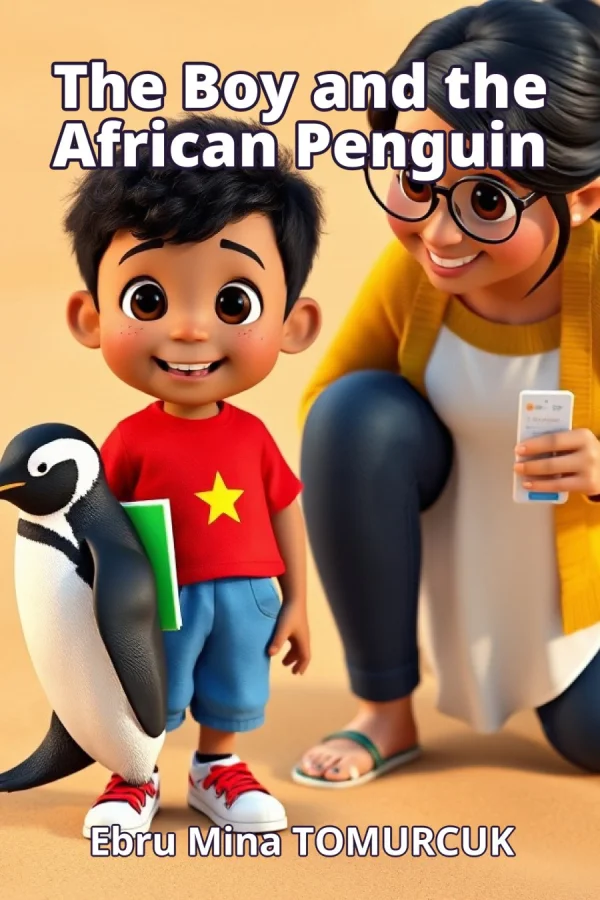
The Boy and the African Penguin
Ebru Mina TOMURCUK
- Category Children's Fairy Tales
- Format PDF
- Size 11.0 MB
- Views 2
Leo loves science, so when his teacher asks the class to pick an animal for a project, he chooses penguins without hesitation. At home he tells his mother that penguins live where it is cold, among ice and snow, and together they walk downtown to the library to learn more. There Leo reads about emperor penguins in Antarctica and about penguins in New Zealand and Australia, and then he finds a page that changes his idea completely: the African penguin, a bird that lives on the sandy coasts of southern Africa, digs burrows in the sand to stay cool, and has bare pink skin above its eyes that helps it lose heat. Africa is hot, Leo thinks, and yet here is a penguin standing on warm sand.
The discovery stays with him. In his imagination a small African penguin waddles out of a burrow and tells him it likes the warmth, and Leo writes in his green notebook that African penguins belong to warm sand, not ice. At school he draws two homes side by side, one snowy and one sandy, and colors the African penguin with its pink eye patches and black chest stripe. When he presents his work to the class, his classmates lean in, surprised that a penguin could live somewhere warm, and their questions push him to explain how the burrow keeps the bird cool and how it swims in the ocean but rests on the sand.
The story follows a curious, freckled boy who trusts books and his own questions, and a mother who takes him to the library and lets him explore. It teaches young readers that animals do not all fit in one box, that nature is full of surprises, and that finding out you were wrong can be the most exciting part of learning. It suits children beginning to do simple research projects and the adults who read alongside them.
Read the Book
If the PDF does not appear, open it in a new tab.
A Chapter from the Book
The Boy and the African Penguin - Author : Ebru Mina TOMURCUK
Leo loved science more than anything. His teacher said, "Pick an animal for your project." Leo tapped his green notebook with his pencil. He had freckles across his nose and a gap between his front teeth when he smiled. "Penguins!" he said. He wrote PENGUINS in big letters and drew a little star next to it. 1
At home, Leo told his mom all about his plan. She wore her mustard cardigan and round glasses. "Penguins live where it's cold," Leo said. "Ice and snow everywhere!" Mom smiled. "Let's go to the library and find out," she said, holding her library card. Leo grabbed his green notebook and they walked downtown together. 2
The library had a whole shelf about penguins. Leo pulled out book after book. He read about emperor penguins in Antarctica. He read about penguins in New Zealand and Australia. Then he found a page with a strange penguin. It had pink patches above its eyes and a black stripe across its chest. "African penguin?" Leo whispered. "In Africa?" 3
Leo read the page again. African penguins live on the sandy coasts of southern Africa. They dig burrows in the sand to stay cool. They have bare pink skin above their eyes that helps them lose heat. "But Africa is hot!" Leo said. He looked at the picture of the penguin standing on warm sand. This was not what he expected at all. 4
Leo closed his eyes and imagined. In his mind, a small African penguin waddled out of a sandy burrow. It was about kneehigh. Its black back shone in the sun. "Hello!" said the penguin. "Is it cold here?" Leo asked. "Not at all," said the penguin. "I like the warmth. Sand and shade are my home." Leo laughed out loud in the library. 5
Mom looked over. "What's so funny?" she asked. Leo showed her the African penguin page. "I thought all penguins loved ice," he said. "This one lives in a warm climate!" Mom nodded. "Nature is full of surprises," she said. "That's why we keep exploring." Leo wrote in his green notebook: African penguins = warm sand, not ice. 6
At school, Leo worked on his project. He drew two big pictures. On one side, he drew a snowy home with ice and a cold blue sky. On the other side, he drew a sandy burrow under a bright sun. He colored the African penguin with its pink eye patches and black chest stripe. He added rocks for shade and a little sand dune. 7
Leo practiced his presentation at home. He told his mom, "Penguins don't all fit in one box. Some like it cold. Some like it warm." Mom smiled and said, "You're right. That's an important lesson." Leo felt proud. He tucked his green notebook and pencil into his pocket and went to bed early, ready for the next day. 8
The next morning, Leo stood in front of his class. His heart beat fast. He held up his drawing of the snowy penguin home. "Most penguins live where it's cold," he said. "But some penguins live where it's warm!" He pointed to the sandy burrow. "This is an African penguin's home." 9
His classmates leaned in. A girl with a ponytail and glasses gasped. "Penguins in Africa?" she asked. "Really?" Leo nodded. "They dig burrows in the sand to stay cool," he said. "And they have pink patches above their eyes to lose heat." The class looked at his drawing with wide eyes. They had never heard of a warm-weather penguin. 10
Leo passed around his green notebook. His friends pointed at the pink eye patches and the black chest stripe. "Does it swim?" asked one boy. "Yes," said Leo. "It swims in the ocean, but it rests on warm sand." Another girl asked, "Is it hot in that burrow?" Leo said, "The sand keeps it cool." Everyone wanted to know more. 11
The teacher smiled. "Leo, your project is wonderful," she said. "You showed us that not all animals fit our expectations." Leo grinned, showing the gap between his teeth. He felt happy. His classmates clapped. They said, "We want to see more penguins!" Leo promised to bring more books from the library. 12
After school, Leo went back to the library with Mom. He found books about other surprising animals. "There's so much to learn," he said. Mom hugged him. "That's the best part," she said. "Nature is full of surprises." Leo wrote in his notebook: Surprises make nature exciting. He drew a little star next to it, just like the one on his shirt. 13
That night, Leo lay in bed and thought about the African penguin. He imagined it waddling on warm sand under a bright sun. It looked happy. Leo smiled. He learned that animals can live in places we don't expect. And that makes the world more fun to explore. He couldn't wait to discover more. 14
The next week, Leo brought his project to the school science fair. His drawing of the sandy burrow stood next to the snowy one. Classmates gathered around and asked questions. Leo answered each one with a smile. His teacher gave him a special sticker. "You taught us something new," she said. 15
Leo learned a fun lesson. Not all penguins love the cold. Some live in warm climates with sandy homes. And not all animals fit our expectations. That makes nature even more exciting to explore. Leo looked at his green notebook and smiled. He couldn't wait for his next science project. The world was full of surprises.
This section is a preview taken from the book (about 943 words). To continue, read the book or download the PDF.
Book Details
- Book
- The Boy and the African Penguin
- Author
- Ebru Mina TOMURCUK
- Category
- Children's Fairy Tales
- Language
- English
- Format
- PDF · 11.0 MB
- Pages
- 18
- Words
- about 944
- Published
- onlinemasal.com.tr
- Access
- Free to read and download; for personal use only, all rights belong to the author.
Frequently Asked Questions
Is the PDF of The Boy and the African Penguin free?
Yes. The Boy and the African Penguin can be read and downloaded for free on this site; no sign-up or payment is required.
How many pages is The Boy and the African Penguin?
The Boy and the African Penguin has 18 pages and about 944 words.
Which devices can I read The Boy and the African Penguin on?
It is a PDF; you can read it in your browser on a phone, tablet or computer, or download it and open it offline.
Who is the author of The Boy and the African Penguin?
The Boy and the African Penguin was written by Ebru Mina TOMURCUK; it is listed in the Children's Fairy Tales category.